Transferring a Brand, Software or a Customer Base Within a Group: How to Justify the Price?
Imagine a situation: over several years, a company successfully develops its business. As a result, brand recognition is built, software and internal systems are developed, know-how is accumulated and a stable customer base is established. The intangible values listed above are not separately identified or legally registered.
As the company grows, the owners and management decide to put the group structure in order and establish a separate company which will manage the group’s intangible assets going forward. The trademark, software rights and other intellectual property are registered in the name of the new company. This company then licenses these intangible assets to the other group companies.
Is the registration of ownership of the intangible assets in the new company’s name enough for it to also own all the economic value previously created?
In this article, we will look at the key questions that arise when intangible assets are transferred within a group or a related restructuring is carried out. We will analyse how to determine the actual substance of the transaction and the value being transferred, what conditions and restrictions must be taken into account in setting and applying the transaction price, and how to justify that price. We will also assess the impact of a restructuring on the functions, risks and profit allocation of the companies involved. At the end of the article, we will look at a practical example.
What is actually transferred? Identifying the asset
Under the OECD Transfer Pricing Guidelines, an intangible asset is an asset that is not a physical or financial asset, which can be controlled and used in business activities and for whose use or transfer an independent enterprise would be willing to pay. Intangible assets include both registered intellectual property, such as trademarks and patents, and unregistered assets, such as a brand, software, know-how, trade secrets and customer relationships. Such assets can materially affect a company’s ability to generate revenue and profit.
Intangible assets can be very diverse, including software and other technological solutions, data, licences, customer contracts and relationships, know-how, processes, methods, trade secrets and other resources used in the company’s operations. For example, the value of customer relationships may be made up of existing contracts, the history of past cooperation, access to customers and the likelihood of repeat business.
Therefore, in transactions involving intangible assets, the first step is to determine precisely which assets are being transferred and what rights their recipient acquires.
In the case of a brand, the trademark must be distinguished from the brand itself. A trademark provides legal protection, whereas the value of a brand is determined by its recognition, reputation, customer loyalty and impact on demand for the product. It must therefore be assessed in which markets the brand is established, which company has developed and financed it, and what investment is needed to maintain its position.
Legal ownership of an intangible asset does not in itself always determine which company is entitled to the economic benefits/profit associated with the intangible. The OECD DEMPE analysis assesses which company actually performs and controls the development, enhancement, maintenance, protection and exploitation of the asset, as well as finances these activities and assumes the related risks. Accordingly, the allocation of profit within the group must also correspond to the functions actually performed and the risks assumed. The importance of this question is also illustrated by the US , in which the dispute concerned the reallocation of approximately USD 9 billion of profit between group companies - the court sided with the tax administration, holding that the allocation of profit must follow the ownership of the intangibles and the functions actually performed.
How is the transaction price determined?
To determine the value of an intangible asset, a valuation needs to be prepared. The market price of an intangible asset cannot be determined using a single universal formula. The appropriate method depends on the type of asset, the information available, the circumstances of the transaction, the economic benefit the asset can generate for its owner, and other factors. Latvia’s transfer pricing rules are based on the OECD Guidelines, which in transactions involving intangible assets allow the use of both transfer pricing methods and generally accepted valuation approaches.
In practice, the first step is to assess whether information is available on comparable transactions between unrelated parties. If sufficiently similar transactions do not exist, the value is usually determined by reference to the asset’s ability to generate income or other economic benefits in the future. The cost approach, in turn, may be suitable for simpler and easily replaceable assets, but it often does not reflect the actual profit potential of a brand, customer relationships or another unique asset.
Regardless of the method chosen, the valuation must be performed from the perspective of both parties to the transaction. The seller would normally not be willing to give up the asset for a price lower than the benefit it could obtain by keeping it. The buyer, in turn, would not pay more than the benefit it reasonably expects from using the asset. The considerations of both parties determine the possible range of the market price.
Key assumptions that determine the value
In practice, the valuation of intangible assets rests on many assumptions. Accordingly, the outcome of a valuation is fundamentally affected both by the calculation method itself and by the assumptions underlying it.
Useful life
The asset’s useful life must be determined in line with its economic substance. Without further investment, technological solutions can become obsolete relatively quickly, whereas a brand can retain its value for longer if it is continuously developed and maintained. For customer relationships, customer retention and the expected duration of the relationship are key. For example, if 12% of customers are lost each year, this directly affects the period over which the existing customer base will be able to generate income. In the US case, the court rejected a valuation in which the transferred technology had in effect been assigned an unjustifiably long economic life.
Cash flow projections
Cash flow projections must be supported by information that was available at the time of the transaction and consistent with the company’s budgets and business plans.
The soundness of projections is particularly important in the case of hard-to-value intangibles. In certain circumstances, the OECD HTVI approach allows the tax administration to use later actual results to test whether the projections used and the price set at the time of the transaction were justified. Material deviations from the projections must therefore be capable of being explained by circumstances that could not reasonably have been foreseen at the time of the transaction.
Discount rate
The discount rate must reflect the risk associated with the specific asset and its future income. The company’s average cost of capital can be used as a starting point, but the risk of an individual intangible asset may be higher or lower than the company’s overall risk. At the same time, the assumptions used must be mutually consistent - the discount rate cannot be detached from the company’s overall return on capital and from the risk of the other assets included in the valuation. Even small changes in the discount rate can materially affect the calculated value.
What happens after the transaction?
The justification of the transaction price in tax planning does not end with signing the agreement, making the payment and registering the change of ownership. After an intangible asset has been transferred, it must also be assessed how its further management, development and use are actually organised. If, after the transaction, the essential functions and the decision-making related to the asset still remain in another group company, it must be considered whether the chosen transaction model corresponds to the actual situation. Legal ownership matters, but it must be assessed together with the functions actually performed, the assets used and the risks assumed.
It must likewise be ensured that payments made after the transaction are consistent with the initially determined price of the asset. For example, if an asset is sold at a relatively low price but a substantial licence fee is then paid for its use, the question may arise whether the sale price fully reflected the economic value of the transferred asset. Conversely, a licence fee may be justified even in a period when the user of the asset is loss-making, if it can be demonstrated that the asset actually generates an economic benefit for it.
When reviewing the transaction, the tax administration may look at it from both an ex ante and an ex post perspective. The ex ante view assesses the information, projections and risks that the parties knew or could reasonably foresee at the time the transaction was concluded. The ex post view, in turn, also takes into account the actual results after the transaction, including revenue and profit, to test the soundness of the initial assumptions. If the actual results differ materially from the projections and the deviation cannot be explained by circumstances that could not reasonably have been foreseen at the time of the transaction, the tax administration may have grounds to challenge the price set and to make a tax adjustment.
If future results are particularly uncertain at the time of the transaction, the agreement may provide for a price adjustment mechanism, linking part of the consideration to the actual results over a defined period after the transaction.
All together or in parts: when does a set of assets become a business?
If, within a single transaction, a brand, a platform, customer contracts and other interrelated assets, obligations and the rights arising from them are transferred, such a package may be regarded not as a set of individual assets but as a business or an independent part of a business. The total value of a working business can exceed the sum of the values of the individual assets, because it also includes the interaction between those assets, the established market position and the profit potential.
Two Israeli cases mark this boundary well. In the (2017), a Microsoft subsidiary transferred its intellectual property to the group for USD 26 million a few months after the group had bought its shares for USD 90 million. The court agreed with the tax administration: what had actually been transferred was the entire business, with its team and customer relationships, the value does not “evaporate”, and the price was set at USD 80 million. In the (2019), by contrast, the court sided with the taxpayer: after the restructuring, the Israeli company continued to operate and even grew, so the package of licence and service agreements could not be recharacterised as a sale of the entire business. The line is drawn by the facts - what stayed, what left and whether the remaining company has an independent future.
Chapter IX of the OECD Guidelines on business restructurings points in the same direction: if a company loses profit potential by transferring “something of value”, it is entitled to compensation for it. In Germany, for example, this concept is written explicitly into law - in a relocation of functions, the entire “transfer package” is valued together with its profit potential, rather than individual assets. In Latvia, if the transferred set of assets constitutes an undertaking within the meaning of the Commercial Law, the acquirer takes over the obligations associated with the undertaking by operation of law (Section 20 of the Commercial Law), and case law establishes a transfer of an undertaking on the basis of a set of indicators: employees, fixed assets, location, customer relationships. From a VAT perspective, a transfer of an undertaking is not a taxable transaction, whereas the sale of individual assets in a cross-border transaction is generally taxable in the recipient’s country. The “assets or business” qualification must therefore be determined already at the transaction planning stage.
What does this mean in Latvia?
In Latvia, when reviewing an intangible asset transaction carried out within a group, the State Revenue Service (VID) may assess not only the price of the transaction but also its actual substance - namely, whether individual assets are being transferred or an interrelated set of assets, rights and functions which in substance constitutes a business or an independent part of a company. This affects the determination of the transaction’s value. Likewise, the VAT treatment of the transaction may also differ, which is no less important to take into account.
If VID concludes that a Latvian company has sold an asset (or a business) at a price below the market price, or acquired it at a price above the market price, the difference must be included in the base subject to corporate income tax as conditionally distributed profit. The tax risk runs in both directions - both where a Latvian company sells an asset at too low a price and where it acquires an asset at too high a price.
In that case, the adjustment amount is divided by a coefficient of 0.8 and taxed at the 20% corporate income tax rate, which effectively corresponds to a 25% tax on the adjustment amount. In addition, late payment interest may be charged and, depending on the circumstances of the case, also a penalty.
The transfer of a significant intangible asset or of an interrelated set of assets may be precisely the case where it is worth considering an advance pricing agreement (APA) with VID on the methodology for determining the market price. Such transactions are usually one-off and methodologically complex, their value is often based on projections and assumptions with a high degree of uncertainty, and comparable market transactions may not be available. However, given the length and complexity of the APA process, before starting it, it should be assessed whether it is a proportionate and practically suitable solution in the specific situation.
A practical example: the platform, brand and customers move to Lithuania
Since 2017, SIA DEMO Soft has been developing an IT product in Riga - the fleet management platform DemoFleet. The platform operates on a subscription business model. The platform has been developed by SIA DEMO Soft’s management and employees, who have defined its functionality, organised the development and ensured its further improvement.
The development of the platform has been financed by the group’s parent company, UAB DEMO Group, which has regularly granted loans to SIA DEMO Soft since development began. The platform development work, the making of key decisions and the functions related to its development are actually carried out by SIA DEMO Soft’s management and employees.
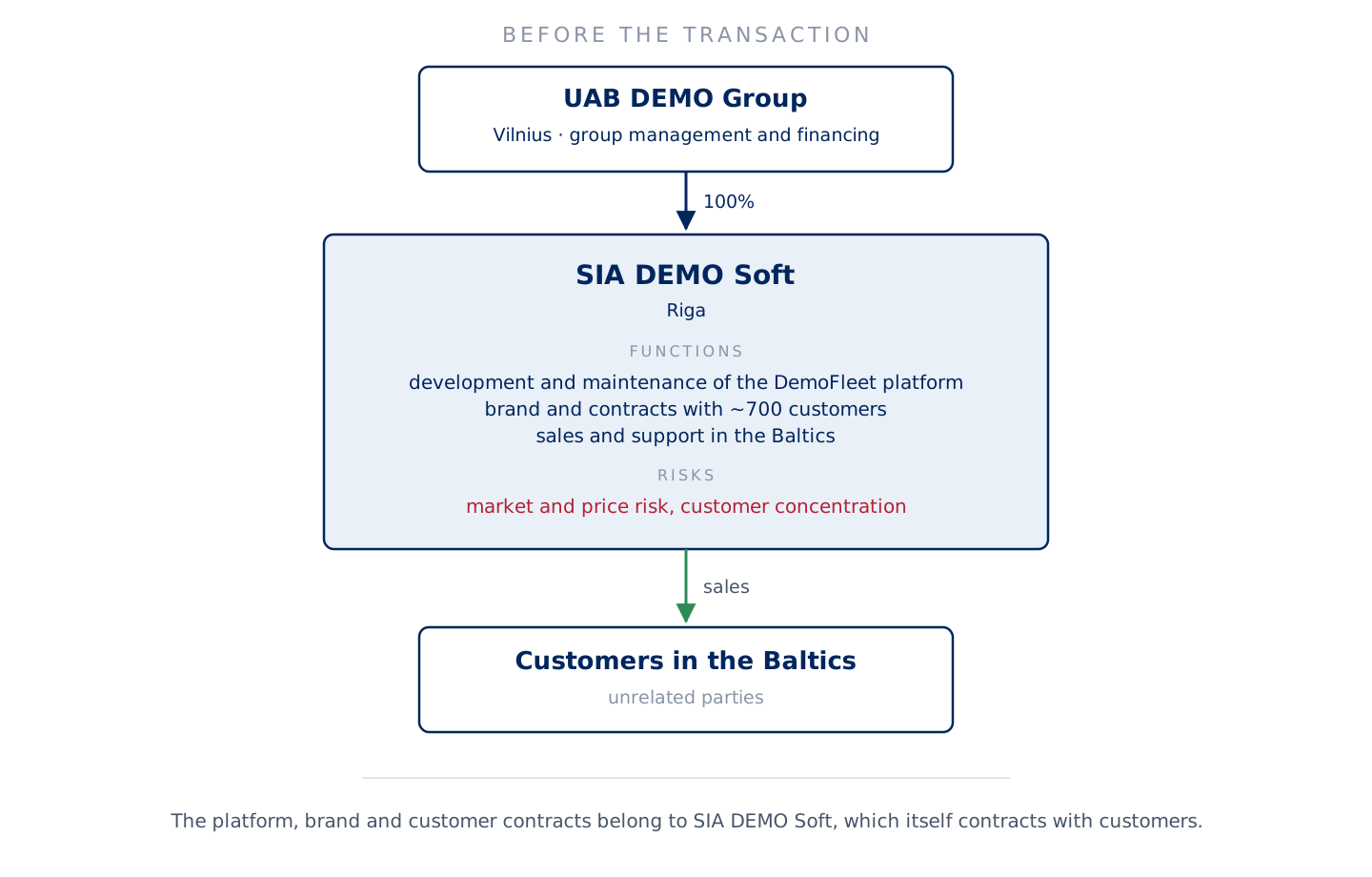
In preparation for attracting an investor, UAB DEMO Group decides to concentrate the rights to the platform and the brand, as well as the customer contracts, in one company. After the transaction, SIA DEMO Soft will continue to provide platform development and support functions, receiving remuneration for them on a cost plus basis.
At the time of the transaction, SIA DEMO Soft has around 700 active customer contracts in the Baltics, annual revenue reaches EUR 4 million, and a team of 35 employees is involved in developing and maintaining the platform and serving customers. The company has created not only the technological solution itself but also the related know-how, brand recognition, customer relationships and a regular stream of subscription revenue.
Each transferred component is identified and valued separately:
- the platform - using the Royalty Relief method: a 5% licence rate (in the range of comparable B2B software licences), a 7-year useful life, a 12% discount rate;
- the brand - using the Royalty Relief method: a 1% rate, a 10-year period;
- the customer base - using the Multi-Period Excess Earnings (MEEM) method for existing contracts only: 12% annual churn, a 13% discount rate.
A tax amortisation benefit is added for all components, because the buyer in Lithuania will amortise the assets (profit tax rate of 16%).
Platform calculation by year (EUR thousand):
| Year | Projected revenue | Royalty 5% | After tax (16%) | Present value (12%) |
|---|---|---|---|---|
| 1. | 4,000 | 200 | 168 | 150 |
| 2. | 4,400 | 220 | 185 | 147 |
| 3. | 4,752 | 238 | 200 | 142 |
| 4. | 5,037 | 252 | 212 | 134 |
| 5. | 5,289 | 264 | 222 | 126 |
| 6. | 5,501 | 275 | 231 | 117 |
| 7. | 5,666 | 283 | 238 | 108 |
| Total | 925 | |||
| With tax amortisation benefit (TAB) | ≈ 1,032 |
This calculation is a deliberately very simplified illustrative example. It does not take into account several aspects that are essential in a valuation, such as terminal value, and in a real situation the calculation would be considerably more complex.
Summary of the transferred assets (EUR thousand):
| Asset | Method and key assumptions | Value |
|---|---|---|
| Platform | Royalty Relief: 5%, 7 years, 12% | ≈ 1,030 |
| Brand | Royalty Relief: 1%, 10 years, 12% | ≈ 270 |
| Customer base | MEEM: 12% attrition, 13% | ≈ 500 |
| Total | ≈ 1,800 |
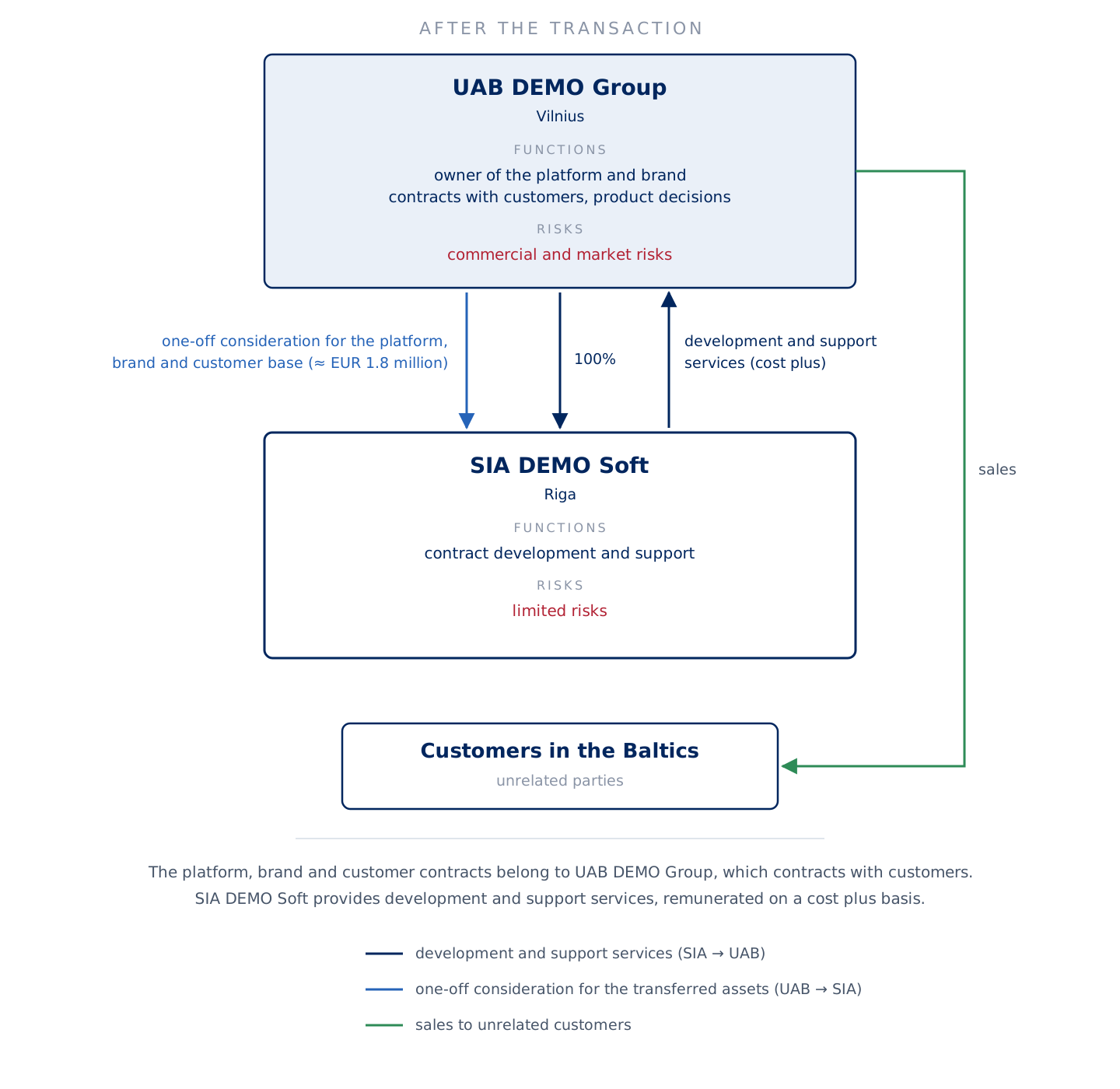
For comparison: if the transaction were structured based on accounting data, for example at the residual amount of capitalised development costs of EUR 1 million, the difference of EUR 0.8 million could create corporate income tax consequences in Latvia of around EUR 200 thousand, not counting additional sanctions - late payment interest and penalties.
What to assess before the transaction?
Before an intangible asset is transferred within a group, it is necessary to clearly define the subject of the transaction, its economic rationale and the tax consequences. Accordingly, the following should be assessed:
- What is actually being transferred? It is necessary to identify not only the assets formally listed in the agreement, but also the related rights, data, documentation, know-how, contracts, employee competences and functions.
- Are individual assets or part of a functioning business being transferred? If customers, employees, contracts, processes or other components necessary for carrying on the activity are taken over together with the intangible assets, the transaction may in substance be regarded as a transfer of an undertaking or of an independent part of it.
- What functions and profit potential pass to the acquirer? It must be assessed which party will make the key decisions after the transaction, control the risks related to the asset, finance its development and perform the functions necessary for its maintenance and commercialisation.
- What assumptions is the transaction value based on? The financial projections used, the asset’s economic useful life, growth rates, profit margins, the discount rate and other key assumptions must be justified. They must be mutually consistent and coherent with the company’s budgets, business plans and the information provided to investors or financiers.
- Have the perspectives of both parties been taken into account? The transaction price must be justified from the perspective of both the seller and the buyer, taking into account the alternatives realistically available to each party, the expected economic benefits, the risks and the tax regime applicable in the relevant country.
- Is the transaction price consistent with the other relationships within the group? It must be verified that the licence payments, service fees, financing terms or other payments envisaged after the transfer of the asset do not duplicate the consideration already included in the transaction price and that they correspond to the parties’ actual functions.
- How will value uncertainty be addressed? If the value of the asset depends to a large extent on uncertain future projections, variable consideration, a deferred payment or a price adjustment mechanism linking the final price to the asset’s actual performance may be considered.
- Is the transaction properly documented at the time it is carried out? The rationale for the transaction, the valuation, the key assumptions and the parties’ decisions must be recorded during the preparation of the transaction. The transfer pricing documentation should reflect the information that was available at the time the transaction was concluded, rather than a justification created only after a request from VID.
The transfer of intangible assets within a group is not in itself problematic. The risk arises where the legal form of the transaction, its economic substance, the price set and the subsequent allocation of functions do not match each other. The most important thing is therefore to establish clearly, before the transaction, what is being transferred, what profit potential passes to the acquirer and what assumptions the price is based on. If these elements are mutually consistent and justified in good time, the transaction can be convincingly defended also in a later VID audit.