How to set up a group structure effectively
A practical guide to setting up a group structure, separating risks and the related tax considerations.
As a business grows, a single company often ends up holding several lines of business together with the related assets, functions and risks. Such a business management structure, with everything concentrated in one company, may at first seem suitable because of its simplicity, but over time, as the business develops, it can create significant risks and reduce the company’s flexibility for further development.
This article looks at when it can make sense to split a business, including to separate risks, functions or assets, what legal routes are available in Latvia, and what their main tax consequences, advantages and limitations are. At the end of the article, these issues are illustrated with a simplified example.
Why split a business?
A business split is usually considered when there is a specific goal or practical need behind it. Such a need can arise as the company grows and its operations expand, as distinct business lines take shape, or when changes to the ownership or legal structure are being planned, among many other scenarios that occur naturally in business. Separation can be considered, among other things, to ring-fence risks and assets, to allocate functions and responsibility more clearly, to improve the financial transparency of individual business lines, or to prepare for bringing in an investor, a sale of the business, a change of owners or other similar situations.
The possible separation solutions and structures vary widely, and the most suitable model depends on the goal to be achieved, the company’s needs and the specific facts.
Separating functions and accountability
Where several distinct business lines operate within one company, it can be difficult to establish clearly which people or units take the relevant decisions, manage particular resources and answer for the related risks. The financial results are also ultimately reported as a single whole, and separate accounting can be complicated.
Placing the business lines in separate companies makes it possible to define precisely the functions each company performs, the assets it uses, the risks it assumes and the scope of its responsibility. This supports more transparent governance, clearer decision-making and a more effective assessment of each line’s results.
Separating risks and assets
In the course of its operations, every business inevitably faces various commercial and legal risks which, in certain circumstances, can materialise as claims, losses or other significant liabilities.
A limited liability company answers for its obligations with all of its assets. If all business lines and assets are concentrated in one company, the materialisation of a single risk can put the company’s entire estate at stake, including assets that have no direct connection with that risk. Placing distinct business lines and valuable assets in separate companies therefore makes it possible to limit the impact of risks. Real estate is a typical example: value accumulated over years that there is not always a good reason to expose to the risks of manufacturing or other day-to-day operations. Different business lines can be separated on the same logic, so that the failure of one line does not directly endanger the other.
Legal routes for separating a business
Once the goal of the split and the intended legal structure have been defined, the next step is choosing the legal route best suited to the situation. The choice is influenced by what is to be separated (the whole company, a self-standing part of the business or only specific assets), as well as by the transfer of contracts, employees and liabilities, the timeline, financing and the tax consequences.
In practice, the options are a reorganisation, a transfer of an undertaking or part of it, disposals of individual assets, share transactions, or a combination of several of these.
Reorganisation by division
The Latvian Commercial Law provides for two forms of division. In a split-up, the original company ceases to exist and its estate passes to two or more acquiring companies. In a spin-off, the original company continues to exist, while a defined part of its estate passes to one or more acquiring companies.
A reorganisation involves universal legal succession. In accordance with the division terms, not only assets, contracts, permits and employees pass to the acquiring companies by operation of law, but also the related liabilities and the responsibility for them. It is important to remember, however, that allocating liabilities between the companies does not mean that the other companies involved in the reorganisation are in all cases fully released from liability. For obligations that arose before the reorganisation, the other companies involved in the division may remain liable to the extent and for the period set by law.
The tax rules, in principle, provide for the neutrality of reorganisations (at least for domestic ones). If the statutory conditions are met and the acquiring company continues to use the transferred assets in its economic activity in Latvia, no corporate income tax base normally arises.
A reorganisation is the right fit where functioning parts of the business need to be separated in a single process together with their assets, contracts, employees, liabilities and rights. It is, however, a formal procedure that in practice can be fairly complex and time-consuming.
Transfer of an undertaking or part of it
A business can also be separated contractually, by transferring an undertaking or a self-standing part of it to another company. In that case, what is transferred is not a set of individual assets but a functioning body of assets, rights and obligations (rather than the company’s shares) with which the acquirer can carry on the relevant business.
Where the transfer takes place between related parties, the transaction price must correspond to market value, so in practice a valuation of the undertaking or its part is usually needed. If the transfer is structured as a sale, the financing of the price must also be arranged, because the new company may not initially have sufficient funds. Within a group, this can create loan relationships, which must themselves be on arm’s length terms.
A transfer of an undertaking is not subject to VAT if what is transferred qualifies as an undertaking or a self-standing part of one and the acquirer continues the business concerned. Employment relationships continue in accordance with the procedure set out in the Labour Law.
At the same time, a transfer of an undertaking does not fully release the original company from liabilities incurred earlier. For obligations that arose before the transfer, the transferor and the acquirer remain jointly and severally liable for the period set in the Commercial Law, and this liability cannot be excluded against third parties merely by an agreement between them.
Disposals of individual assets
It is not always necessary to transfer an entire business or a self-standing part of it. Sometimes the aim is to move only a specific asset or several assets, such as real estate, equipment, a trademark or software. If the assets transferred do not together form a functioning business unit, the transaction is not treated as a transfer of an undertaking.
Individual assets can be sold to another group company or contributed to its share capital. This route allows a precise selection of the property to be transferred, but each asset’s transfer has to be documented separately.
Here too, the value of assets transferred between related parties must correspond to market value. The tax consequences have to be assessed for each asset individually. Unlike a transfer of an undertaking, a sale of individual assets can be subject to VAT. For real estate, the state fee for registration in the Land Register and the re-registration formalities also need to be taken into account.
Disposing of individual assets is a flexible solution where only specific property needs to be separated rather than a functioning part of the business.
Share transactions
Share deals play a different role in a restructuring. When the shares of a company are sold or contributed, the company’s own assets, liabilities, employees and the like do not change - only its owner does. A share transaction alone therefore cannot divide several business lines held within one company.
Share transactions are often used as part of a wider restructuring to create the intended group structure, attract investors, pass individual business lines to other owners, or for other purposes.
The advantage of such a transaction is that the company’s operations continue without any individual re-registration of its assets, liabilities, contracts or employees. The tax consequences at shareholder level do, however, need attention. The place and sequence of the share transaction within the overall restructuring should therefore be assessed already at the planning stage.
What changes after the split: functions, risks and transfer pricing
After a business split, functions previously performed within one company are divided among several related companies. Depending on the structure created, transactions can arise between them. The terms of these transactions, including the remuneration, must comply with the arm’s length principle.
For pricing purposes, what matters is each company’s actual role in the group: the functions it performs, the assets it uses and the risks it assumes. The legal split must therefore be matched by the actual conduct of the business: each company must itself carry out the functions allocated to it, take the related decisions and bear the corresponding risks. If the allocation of functions and risks exists only on paper, the State Revenue Service (VID) may challenge both the terms of the transactions and the remuneration attributed to the companies.
An example: from one company to a group
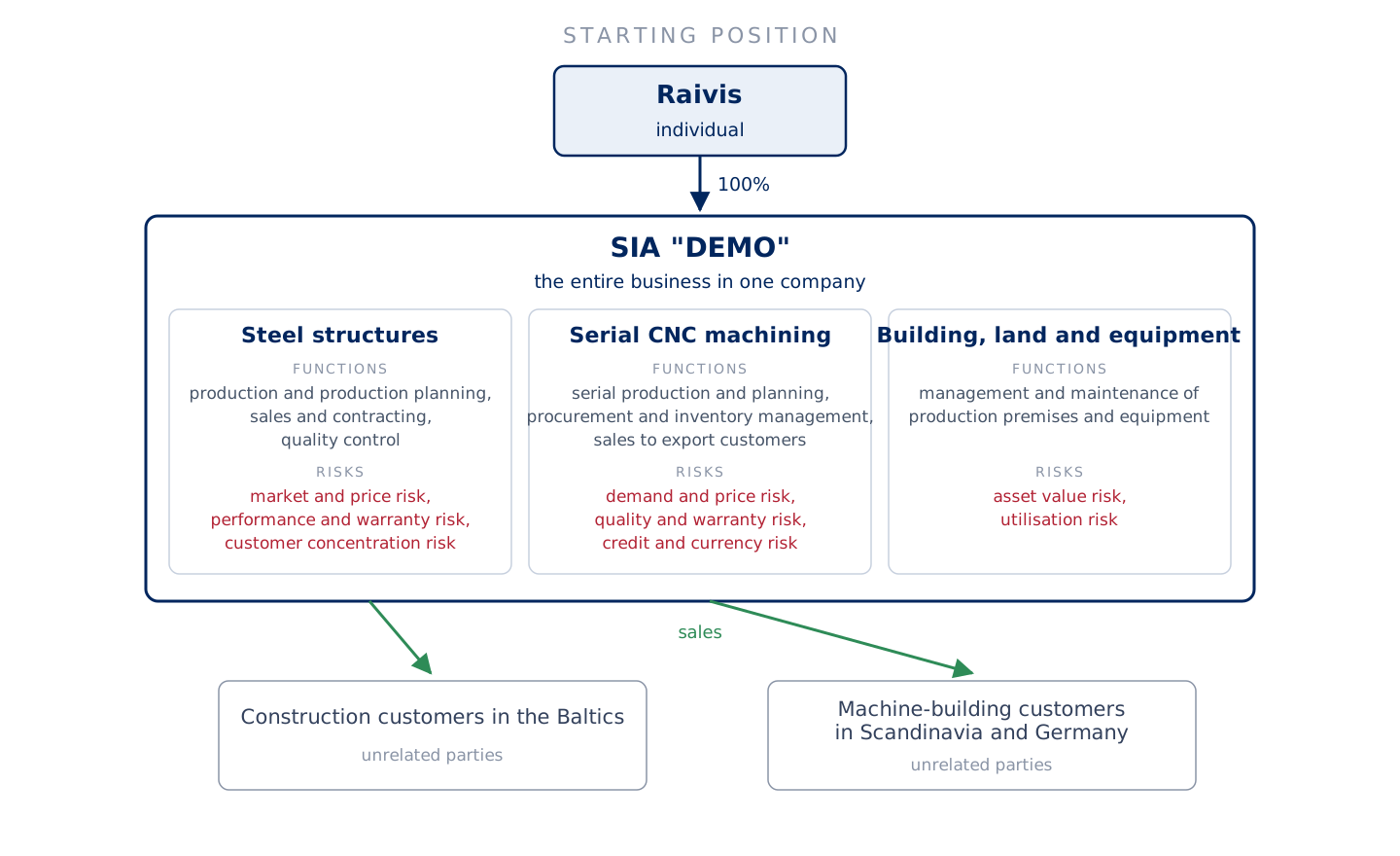
To illustrate the separation process in practical terms, consider a fictional metalworking business, SIA “DEMO”.
The company was founded 20 years ago by Raivis, who had previously worked in the metalworking industry. It started as a small workshop with a few employees, making simple metal products for local customers. Over time it has grown into a fairly large manufacturer with two distinct lines of business:
- fabrication of steel structures for construction projects;
- serial production of CNC parts for machine-building customers in Scandinavia and Germany.
SIA “DEMO” also owns its production building, land and production equipment. In 2025 the company’s turnover was EUR 9.2 million, and its operating profit (EBIT) was EUR 1.15 million. The building and land are worth around EUR 2.6 million, and the equipment around EUR 1.9 million. All shares are still held directly by the founder, Raivis.
Why is the existing structure no longer suitable?
As the business has developed, distinct business lines have formed within one company, which also owns valuable assets and bears the risks attached to them.
The steel structures line works mainly on the projects of one large customer. The contract imposes strict deadlines, broad contractor liability and substantial penalties for delays or quality defects.
Because the entire business is run through one company, potential creditor claims can be enforced against the entire estate of SIA “DEMO”. The risk of the structures business therefore threatens not only the assets connected with that line but everything the company owns.
The existing structure also makes it harder to assess the financial results of the two lines. Costs, assets and profit are accounted for in one company, so the actual profitability of each business is not fully visible.
At the same time, Raivis is considering a future sale of the steel structures business to an independent buyer, which is currently its customer.
Taking these circumstances into account, Raivis decides to restructure the business. First, a holding company is created, into which Raivis contributes his SIA “DEMO” shares; the separate business lines and the valuable assets are then divided off through a reorganisation.
Step one: creating the holding company
Raivis incorporates SIA “DEMO Grupa” and contributes his SIA “DEMO” shares to it.
Both business lines and all assets remain in SIA “DEMO”, but the group’s ownership structure changes: the holding company replaces the individual as the owner of SIA “DEMO”.
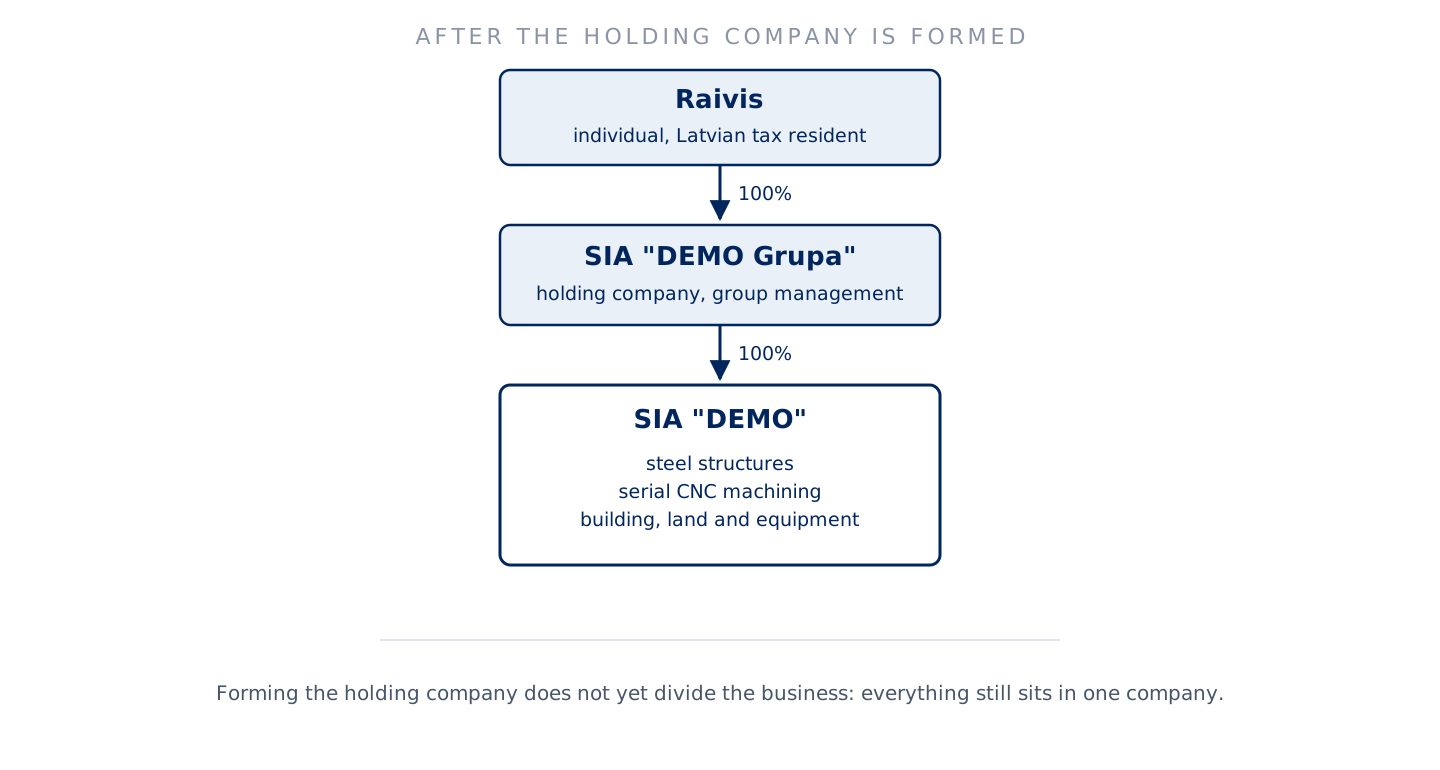
The holding company has several tasks in the new structure. It becomes the group’s management centre, where the key decisions are taken and the subsidiaries’ operations are coordinated. After the restructuring, the holding company can also provide management and administrative services to the group companies.
The holding company can also be significant for a possible sale of the business, which is relevant for Raivis. If an individual sells shares, the capital gain is subject to personal income tax. For a holding company, by contrast, a sale of shares does not in itself normally trigger an immediate corporate income tax charge - as long as the profit is retained in the company and used for further business, payment of the tax is deferred until the profit is distributed or used in another way that is subject to tax. In addition, if the holding company sells shares in a directly held subsidiary that it has owned for at least 36 months, in the cases prescribed by law the income from the disposal can be used to reduce the amount of dividends subject to corporate income tax. A holding structure can therefore both make it possible to keep the sale proceeds within the group for reinvestment and, in certain circumstances, provide a tax relief when they are eventually distributed. This allows the funds received from the sale to be kept within the group structure and used for further investment or other business purposes.
Step two: dividing the business
Once the first step is complete, the two business lines and the assets are separated at the next stage.
Because contracts, employees, rights and liabilities need to be moved in a single process, not only individual assets, Raivis chooses a reorganisation by division (spin-off) as the most suitable route in this situation.
As a result of the reorganisation, SIA “DEMO” is divided, and three separate subsidiaries are created under SIA “DEMO Grupa”:
- SIA “DEMO Īpašumi”, which owns the production building, the land and the equipment;
- SIA “DEMO Konstrukcijas”, which continues the steel structures business;
- SIA “DEMO CNC”, which carries on the serial CNC production.
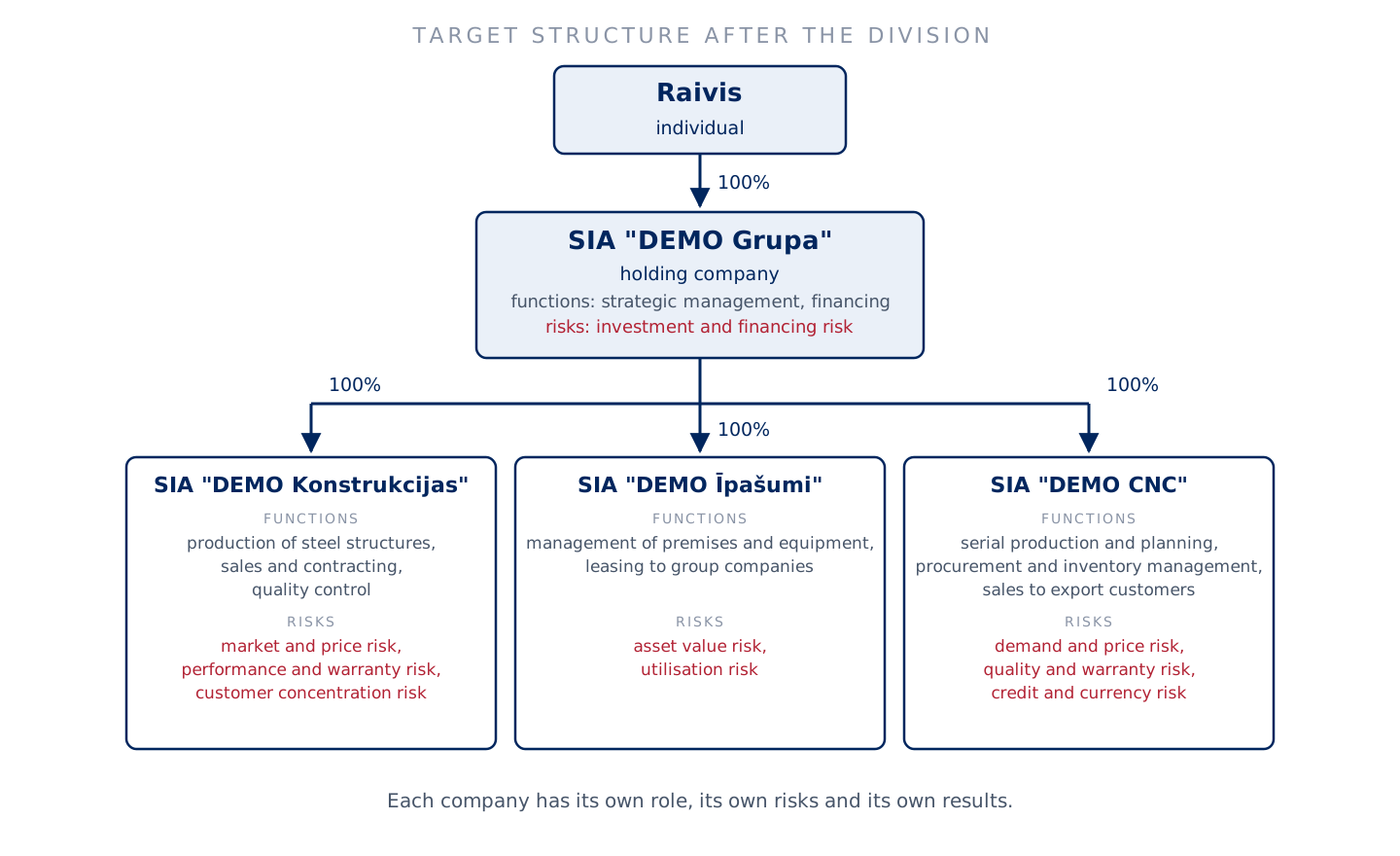
This structure brings several practical benefits.
The contract with the large construction-sector customer, and the commercial risks flowing from it, sit ring-fenced in SIA “DEMO Konstrukcijas”. It should be remembered, however, that liabilities transferred in the course of a reorganisation can also affect the other companies involved in the reorganisation.
SIA “DEMO CNC”, in turn, becomes a self-standing business unit with its own customer contracts, employees, revenue, costs and financial results.
If Raivis later decides to sell the structures business line, an investor can be offered the shares of SIA “DEMO Konstrukcijas” without taking over other group assets or the risks connected with the CNC business. That is more convenient for the seller and the potential buyer alike.
Step three: organising transactions within the group
After the reorganisation, each company performs its own specific functions, but transactions between the group companies now arise.
SIA “DEMO Īpašumi” leases the production premises and equipment to both operating companies. SIA “DEMO Grupa” provides management and administrative services to its subsidiaries. SIA “DEMO Konstrukcijas” and SIA “DEMO CNC” manufacture and sell their products to unrelated customers.
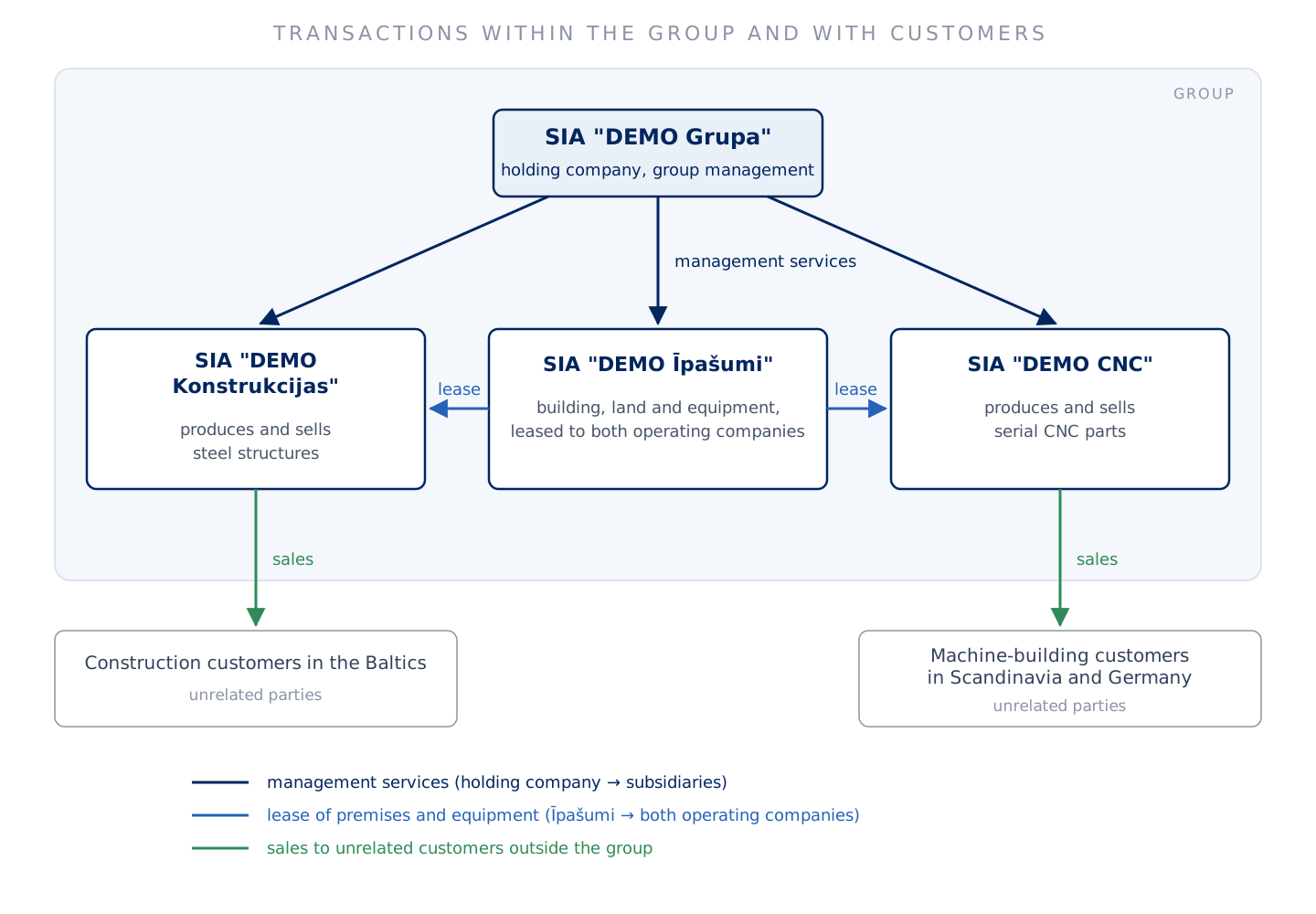
In such a structure, the intra-group transactions must be economically justified and correspond to market prices.
A possible sale of the structures business
If a buyer for the structures business is found later, the transaction can be implemented by entering into a sale of the SIA “DEMO Konstrukcijas” shares.
The buyer acquires a legally and financially separate company with its own assets, contracts, employees and operating results. The rest of the group retains the real estate and the CNC business.
Summary
Not every business needs a multi-company structure. If the business is relatively simple, has one main line of activity and no significant risks or assets to separate, operating through a single company is the most efficient approach.
At a certain stage of a company’s development, separating business lines, assets and risks can be an effective way to create a more transparent structure, protect important assets and prepare the business for further growth, for bringing in an investor, a change of owners or another significant event.
At the same time, there is no single restructuring model that fits every situation. In practice, a business restructuring can be implemented in different ways. The most suitable structure and sequence of steps depend on the nature of the business being separated, its assets, contracts, liabilities, financing, the owners’ goals and the expected tax consequences.
Such a restructuring should therefore be planned in good time: define the goal to be achieved first, and only then choose the legal and tax solution that fits it best.