Is a transfer pricing adjustment a service for VAT purposes? The CJEU’s judgment in “Stellantis Portugal” (C-603/24)


On 13 May 2026 the Court of Justice of the European Union (CJEU) ruled in Case C-603/24 “Stellantis Portugal” on whether a transfer pricing adjustment between related companies amounts to a service subject to value added tax (VAT). The full text of the judgment is available here, and Advocate General Juliane Kokott’s opinion of 15 January 2026 is here.
Within a group, once the financial year closes, a so-called profitability true-up is often carried out. In practice this means issuing adjusting invoices so that the tested company’s annual result matches the profit level agreed in advance and consistent with the arm’s length range. For VAT purposes, tax administrations across the EU have treated such adjustments differently: some as transactions outside the scope of VAT, others as consideration for a service.
The facts
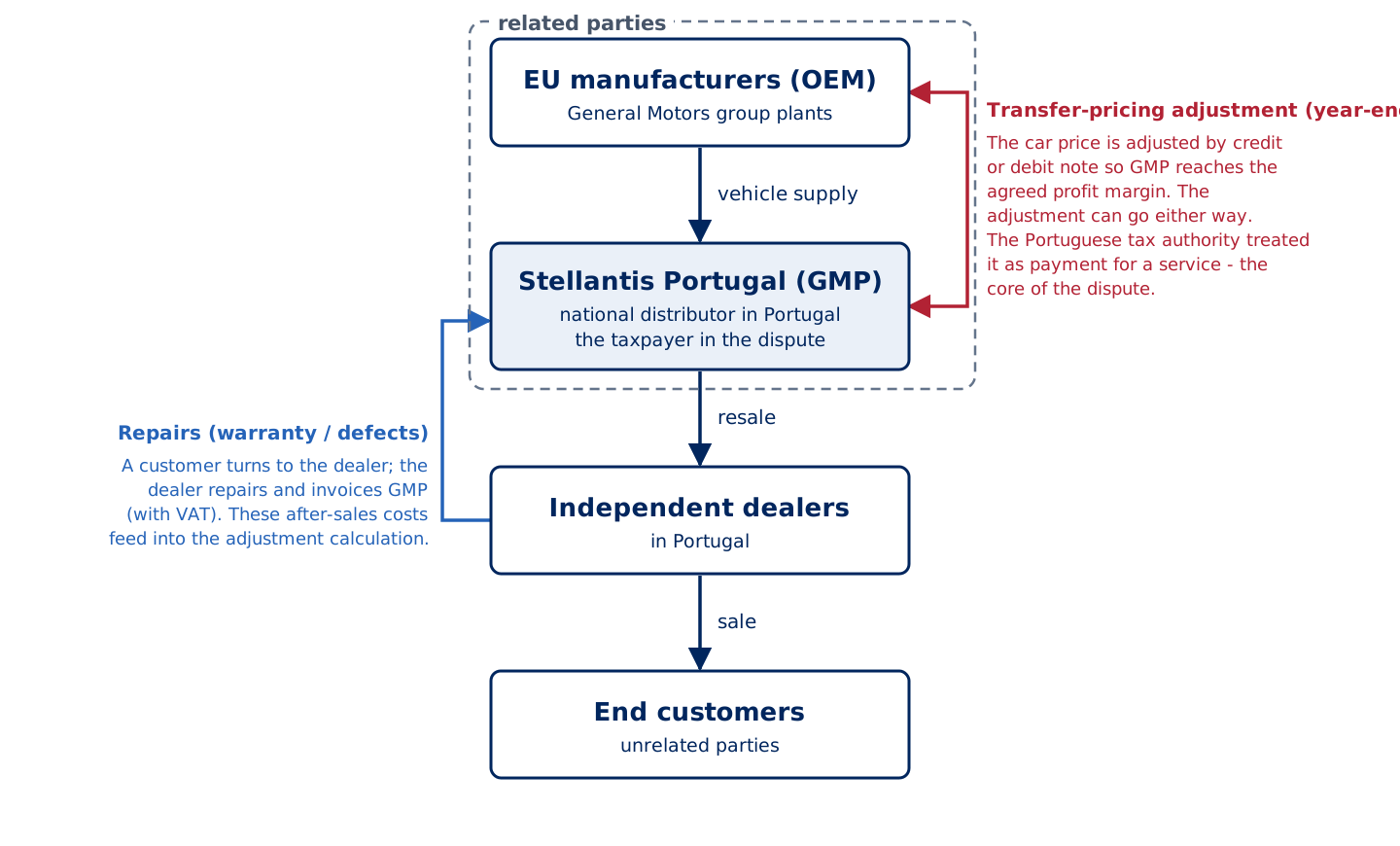
Stellantis Portugal - formerly General Motors Portugal (GMP) - was the General Motors group’s national distributor in Portugal. It bought cars from the group’s European manufacturers (OEMs) and sold them to independent Portuguese dealers, who in turn sold them to end customers.
If a defect arose or a warranty claim was made, the dealer carried out the repair and invoiced GMP for it, with VAT. GMP, in turn, accounted to the European manufacturers (related parties) for all of its distribution costs - not only repairs, but also staff, marketing and so on.
Under a 2004 group agreement, the price of the vehicles was adjusted at year-end so that GMP would reach the profit level the parties had agreed in advance. These adjustments were documented through credit or debit notes issued by the manufacturers. In the year in dispute - 2006 - the price was reduced, so the manufacturers issued GMP credit notes.
What troubled the Portuguese tax authority?
After auditing the 2006 year, the Portuguese Tax and Customs Authority concluded that, in substance, it was the manufacturers - not GMP - who paid for and bore responsibility for the repairs. Its reasoning ran as follows: GMP first covered the after-sales costs and then passed them on to the manufacturers, receiving consideration in the form of a credit note. On that basis the authority concluded that GMP had supplied repair services to the manufacturers and, because those services were performed in Portugal, Portuguese VAT applied. The result was an additional VAT assessment of EUR 1,504,215.49.
In other words, the authority characterised the credit notes not as an adjustment to the price of the cars, but as payment for a service supplied by GMP. That characterisation was the heart of the dispute.
How the case progressed and the question before the CJEU
At first instance - the Tribunal Central Administrativo Sul - the tax authority prevailed: the court upheld the assessment. GMP (later Stellantis Portugal) appealed to the Portuguese Supreme Administrative Court (Supremo Tribunal Administrativo).
It was the Supreme Court that was not convinced the EU VAT concept of “supply of services for consideration” stretched far enough to capture a price adjustment of this kind. It therefore referred a question to the CJEU: must Article 2 of the VAT Directive (77/388/EEC) be interpreted as meaning that “supply of services for consideration” covers an adjustment to the sale price of vehicles, provided for in a contract in order to reach a minimum profit margin and documented through a credit or debit note? Because the year in dispute is 2006, Directive 77/388/EEC applies; its Article 2 corresponds to Article 2 of the VAT Directive 2006/112/EC now in force.
This procedural history also explains why nearly twenty years passed between the year in dispute and the judgment - a point we return to below.
What does EU law require?
Under the VAT system, a service is taxable only where it is supplied for consideration. The CJEU has long held that this requires a direct link between the service and the consideration: there must be a legal relationship between the parties involving a reciprocal exchange of performance, and the payment received must be the actual consideration for an identifiable service. The principle comes from settled case law and was recently confirmed once more in the Latvian case .
The second key element is the taxable amount. Where a payment between the parties alters the price of a supply of goods that has already taken place, it does not create a new transaction but changes the taxable amount of the existing one - reducing it (Article 90 of the VAT Directive) or increasing it (Article 73). In practice this means correcting the original invoice rather than issuing a new invoice for a “service”.
From this follows an important conclusion: a payment between related parties does not, in itself, turn a transaction into a service. What matters is not whether there is a payment, a credit note or a debit note, but what the adjustment reflects in substance.
The Advocate General’s and the Court’s findings
Advocate General Kokott emphasised that the VAT treatment depends on what is being adjusted in substance, and made several important points. First, where the adjustment consists of genuine (not fictitious) and severable services for consideration, those services are subject to VAT. Second, where an adjustment is made later and unilaterally by a tax administration solely in order to allocate profit correctly between two states for income tax purposes, it stays outside the scope of VAT. Third - and this is precisely the Stellantis situation - where the adjustment is achieved through a variable price designed for that purpose and tied to a specific supply of goods, it affects the taxable amount of those goods rather than forming a separate service.
Kokott also pointed to a very practical counter-argument: the adjustment could run in either direction. Had the price risen, it would have been the manufacturers, not GMP, who received the additional money. But it is hard to imagine a service for which, depending on the year’s result, payment flows now one way, now the other.
The Court followed this logic. It held that a transfer pricing adjustment that is provided for in a contract to secure a given profit margin for the distributor, documented through a credit or debit note and calculated by taking into account, among other things, repair costs, is not automatically consideration for a service. The position would be otherwise only if there were a legal relationship between the parties involving reciprocal obligations, under which the distributor undertook to supply a service and the manufacturer paid for it in the form of that adjustment.
The Court relied on three considerations. The 2004 agreement governed a price-and-margin mechanism, not an obligation to supply repair services for consideration. The adjustment was calculated from all distribution costs, not repairs alone, so its connection to repairs was indirect at best. And because the outcome could take the form of either a credit note or a debit note, the very existence of consideration was uncertain - and uncertainty breaks the direct link. The Portuguese government’s argument that GMP acted as the manufacturers’ intermediary in procuring repairs was rejected for want of evidence.
The contrast with is instructive. In that case, in September 2025, the CJEU reached a seemingly opposite conclusion: there, an intra-group charge invoiced to secure a given profitability range under the TNMM was held to be consideration for a service. The VAT treatment therefore turns on exactly this - whether the contract creates an identifiable service and a direct link.
Where the case now stands
An Advocate General’s opinion does not bind the Court, but here the Court followed it. Even so, the CJEU did not settle the final characterisation - it did not say that the adjustment must be treated as a change to the taxable amount of the goods. It left that assessment of the facts to the Portuguese Supreme Administrative Court. The case therefore returns to the national court, which must apply the CJEU’s interpretation to the specific facts. The outcome is nonetheless favourable to the taxpayer: the administration’s original position - that any such adjustment is a service - has not held. At the same time, the case illustrates a practical cost that is easy to underestimate: a dispute over a transfer pricing adjustment can outlive the transaction itself by a full decade or more. Throughout that time the company lives with an open tax position and accruing late-payment interest - and in Stellantis’s case the question concerning 2006 is still not finally resolved.
What does this mean for Latvia?
Many Latvian companies that form part of an international group operate in exactly the roles where a year-end profitability adjustment is made: limited-risk distributors, contract manufacturers, shared service centres. In these cases the TNMM or cost-plus method is typically applied, and at year-end profitability is trued up to the profit margin agreed in advance.
CJEU doctrine is binding in Latvia too, so the Stellantis logic applies to domestic transactions as well. In practice, the VAT treatment of an adjustment depends not on whether a credit note was issued or an accounting statement prepared, but on what the adjustment reflects in substance. Several scenarios are therefore possible. If the adjustment is consideration for an identifiable service with reciprocal contractual obligations, it is subject to VAT (as in Arcomet). If it is a variable-price adjustment tied to a specific supply of goods, it changes the VAT base of those goods and calls for the invoices to be corrected. If it is pure profit reallocation with no link to a specific price or service, it falls outside VAT.
It is worth recalling the practical context that has just changed in Latvia. With the introduction of the controlled-transactions report (KDP), the State Revenue Service (VID) will receive structured information each year on related-party transactions, including how prices are set and how adjustment mechanisms work. What previously surfaced only in an in-depth review of TP documentation will now be visible from the outset. As a result, any mismatch between transfer pricing policy and VAT will become apparent far sooner and on a far wider scale.
The judgment should not be interpreted as meaning that transfer pricing adjustments always fall outside the scope of VAT. On the contrary - where an adjustment has a sufficiently close link to earlier supplies of goods or services, it may give rise to an obligation to correct the VAT base or to issue corrective invoices with VAT.