Can the tax authority challenge any holding structure? The Advocate General’s Opinion in “Neo Group” (C-203/25)


On 21 May 2026, Advocate General Juliane Kokott of the Court of Justice of the European Union (CJEU) delivered her Opinion in Case C-203/25 “Neo Group” - a Lithuanian dispute over whether dividends paid to a Cypriot parent company qualified for an exemption from withholding tax. The Lithuanian tax authority - State Tax Inspectorate (STI) refused the exemption, taking the view that the entire group structure was artificial. The full text of the Opinion is available here.
The case matters well beyond Lithuania. It touches a question that any international group can face in practice: at what point does a structure that formally complies with the law become, in the tax authority’s eyes, an artificial arrangement?
The facts
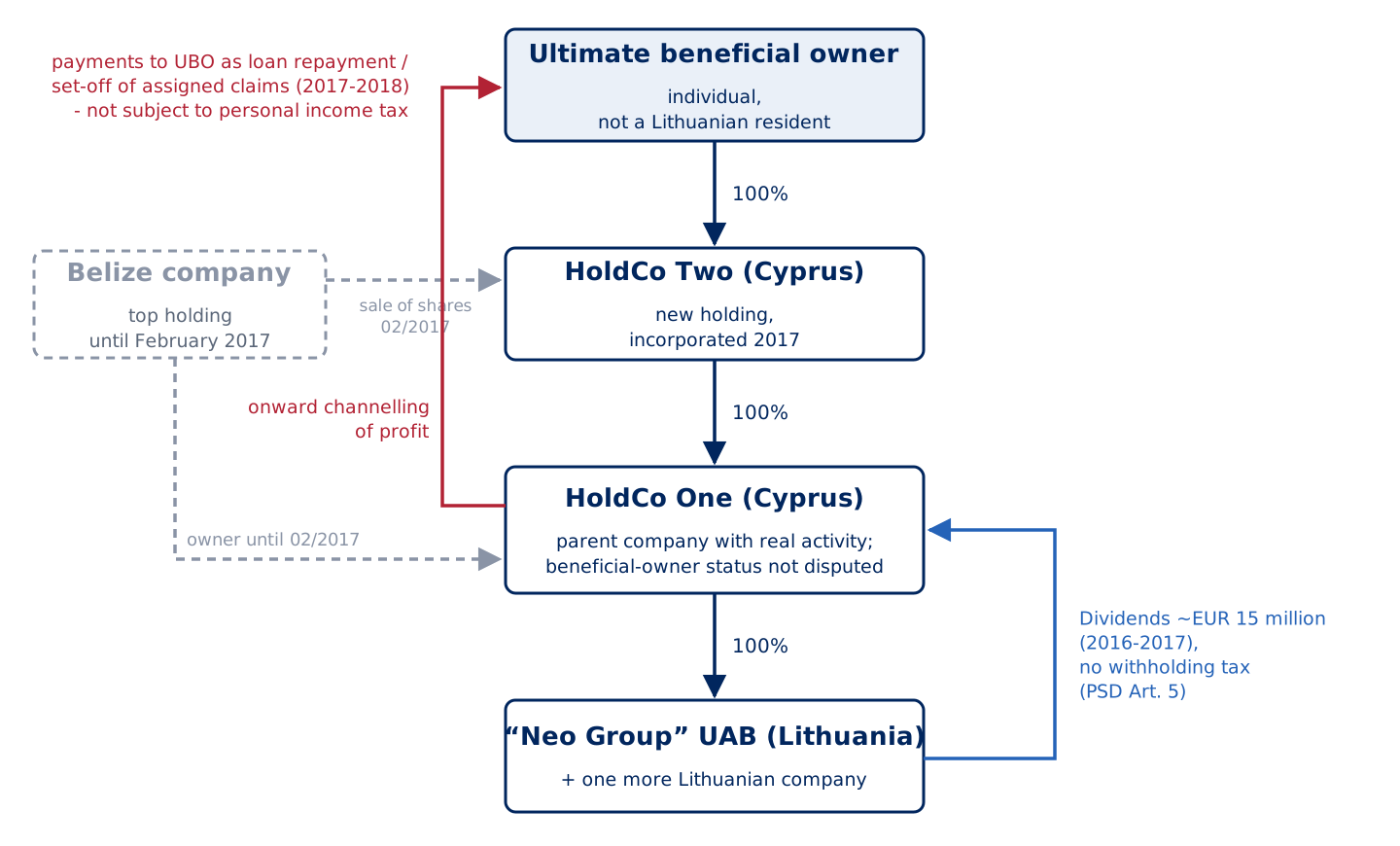
“Neo Group” UAB is a Lithuanian company that, in 2016 and 2017, together with another Lithuanian group company, paid roughly EUR 15 million in dividends to its Cypriot parent. No withholding tax was applied, because the Lithuanian rules transposing the EU Parent-Subsidiary Directive (Council Directive 2011/96/EU on the common system of taxation applicable in the case of parent companies and subsidiaries of different Member States) exempt such dividends from withholding tax.
What happened next drew the STI’s attention. In February 2017, the group’s top holding company - registered in Belize - sold the shares in the Cypriot parent to another, newly incorporated Cypriot company. The ultimate owner before and after the transaction was the same: an individual who is not a Lithuanian resident. In 2017 and 2018 the new Cypriot holding company granted loans to that individual and assigned claims, which were then set off against the individual’s claims on the company - the individual had financed the share acquisition. No dividends were paid to the individual during this period: the money reached them as loan repayments, which are not subject to personal income tax.
What did the Lithuanian tax authority object to?
The STI’s reasoning rested on two observations. First, the dividend amounts paid by the Lithuanian companies matched the amounts channelled onward to the ultimate owner at the Cypriot level. Second, the payments to the ultimate owner were structured not as dividends, which would be subject to income tax, but as loan repayments, which are not.
From this the STI concluded that the holding company’s liabilities towards the ultimate owner had been created artificially, and that the entire group structure was therefore artificial: the only reasonable explanation for the chain of transactions was a desire to move the Lithuanian companies’ profit to the ultimate owner without paying tax at any stage. The consequence - the exemption under the Directive was refused and the dividends were subjected to Lithuania’s 15% withholding tax.
An important nuance distinguishes this case from the CJEU’s previous case law: the STI did not dispute the Cypriot parent’s status as the beneficial owner of the dividends, nor did it question that the parent carries on genuine economic activity. In other words, the case did not rely on the classic argument that the recipient of the dividends is merely a formal shell company through which income is passed on. The STI saw the abuse not in the recipient itself, but in the transactions as a whole - including transactions that took place after the dividends were paid and in another country.
How the case progressed and the questions referred to the CJEU
The taxpayer challenged the STI’s decision before the Lithuanian Tax Disputes Commission (Mokestinių ginčų komisija prie Lietuvos Respublikos Vyriausybės). The Commission acknowledged that in the so-called the CJEU had already formulated criteria for assessing abuse in dividend flows. However, it noted that the facts here differ: in the Danish cases the recipients were passive shell companies with no real activity; here, the recipient was a parent company whose genuine activity was never disputed.
Because the STI’s approach would, in essence, allow almost any holding structure to be challenged, the Commission stayed the proceedings and referred six questions to the CJEU. Among them: whether the exemption may be refused to a parent company that genuinely performs its functions, solely because the payment forms part of an allegedly fictitious chain of transactions; whether artificiality may be presumed from the similarity of amounts alone; whether it matters that the contested transactions took place after the dividends were paid and in another Member State; and whether the paying company even needed to be aware of the subsequent transactions.
What does EU law provide?
The logic of the Parent-Subsidiary Directive is simple: group profit is taxed once - where it is actually earned. Subsequent distributions of that profit within the group are neutral: the receiving state exempts the dividends it receives (Article 4), while the paying state levies no withholding tax (Article 5). At the same time, Article 1(2) and (3) of the Directive contains an anti-avoidance rule: the benefits are not granted to an arrangement put in place mainly to obtain a tax advantage - that is, not introduced for valid commercial business reasons. Here the Directive expressly reflects the principle known in tax law as substance over form: what is decisive is not how a transaction is labelled and documented, but its economic content.
The CJEU has interpreted this rule step by step. In and , it held that Member States may not apply general presumptions of abuse - each case must be assessed individually, and the burden of proof lies with the tax authority. In the Danish cases (2019), the CJEU set out the hallmarks of a conduit company: a company whose sole activity is to receive dividends and immediately pass them on, and which cannot economically dispose of the funds received, is not their beneficial owner. Then, in April 2025, in another Lithuanian case - - the CJEU clarified how such abuse must be assessed. It is not enough merely to identify a formal structure or a tax advantage. Two elements must be proven together: first, that the arrangement is artificial, and second, that its purpose is to obtain a tax advantage contrary to the object of the Directive. Moreover, this assessment is not confined to the moment the dividends are paid - all the circumstances of the case must be taken into account.
The Advocate General’s findings
Kokott’s Opinion in this case continues the CJEU’s established approach and, in several respects, frames it more favourably for taxpayers. The central finding is this: where the conditions of the Directive are satisfied in economic substance - that is, the recipient of the dividends is the beneficial owner and carries on genuine economic activity - this generally indicates the absence of abuse. Receiving dividends and distributing them onward is, in itself, a normal function of a holding company and should not be grounds for suspicion. Nor does the fact that the amounts received and paid on coincide, or that there is a short interval between receiving and onward distribution, in itself prove abusive tax avoidance - accordingly, it is neither a sufficient nor a necessary condition for finding abuse.
At the same time, the Advocate General does not rule out exceptional situations. Abuse may also be found where individual transactions are themselves genuine, but the overall structure is directed at a result contrary to the aim of the Directive. Such a conclusion, however, requires a direct link between the artificiality of the structure and the tax advantage provided for in the Directive. For example, such a link might exist where, after being paid, the dividend flow is channelled to offshore jurisdictions whose information-exchange regime effectively prevents the tax authority from verifying the ultimate recipient of the income and its tax treatment, thereby ensuring that the income is not taxed anywhere. The existence of such a link must be proven by the tax authority.
Three further findings are worth highlighting. First, if the ultimate recipient circumvents the tax rules of its state of residence, that is for that particular state to address - another Member State cannot refuse an exemption provided for under EU law on that basis. Second, a taxpayer is entitled to choose lawful structuring options and to organise its activities so that the tax burden is lower - planning in itself is not abuse. Tax, like any other cost, can be planned by businesses. Third, relocating the top holding company from Belize to Cyprus may have valid economic reasons, such as how banks and counterparties treat offshore jurisdictions. In the Advocate General’s view, the circumstances of this case do not indicate non-payment of tax in Cyprus; however, once the CJEU’s preliminary ruling is received, the final assessment of the facts will be for Lithuania to make.
Status of the proceedings
An Advocate General’s Opinion is not binding on the CJEU, although in practice the Court usually arrives at a solution consistent with the Advocate General’s proposed interpretation. The judgment in Case C-203/25 is expected within the coming months. After the CJEU’s preliminary ruling, the case will return to the Lithuanian Tax Disputes Commission, which will have to apply the CJEU’s interpretation of EU law to the specific facts.
Whatever the final outcome, this case is likely to be one of the most significant CJEU rulings since the Danish cases on the limits of the Directive’s application and on the assessment of abuse in cross-border dividend structures.
What does this mean for Latvia?
Latvia’s situation is somewhat different. Latvia’s corporate income tax regime does not provide for classic withholding tax on dividends paid to an EU parent company.
Nevertheless, the case remains of practical importance for Latvian companies. In cross-border groups, Latvian companies are often used as holding or intermediate holding companies - they receive dividends from subsidiaries and channel the funds onward to owners or other group companies. Latvia’s CIT law provides a regime that, in certain circumstances, prevents received and onward-distributed dividends from being taxed twice.
In this context, what matters is not the mere fact that dividends are received and then paid on, but the Latvian company’s actual role in the overall structure. If a company has an understandable economic function, genuine activity, and was not set up solely to obtain a tax advantage, the onward distribution of dividends is not in itself a sign of abuse. The risk arises where an intermediate holding company performs no real function in substance (acting instead as a shell) and its involvement in the structure serves mainly to achieve a tax result.
This is why the case matters for Latvia - not because it would directly change how Latvian CIT applies, but because it sharpens the framework for thinking about cross-border holding structures. It is a reminder that, for the tax authority, mere suspicion about onward dividend flows or a formal reference to an intermediate company is not enough. At the same time, the taxpayer must be able to explain why the particular structure exists and what the actual role of each company in it is.
What to review now?
For groups with a Latvian element - whether at the top, in the middle, or at the bottom of the structure - this case is a good reason to review your structure with fresh eyes:
- whether each level of the group has a real, clearly articulable economic rationale that is not solely tax-driven - and whether it is documented;
- whether the holding companies have real substance: decision-making, a board, premises or at least traceable activity, their own bank accounts, and discretion over the funds received;
- whether, in pass-through dividend flows, it is clear and demonstrable where the profit ultimately ends up and how it is taxed at the level of the final recipient;
- whether the structure contains additional elements that may raise questions, such as loans, assignments, set-offs, or other instruments by which dividends are effectively replaced or channelled onward;
- whether it is worth proactively aligning your position with the tax authority, for example by obtaining an advance ruling or otherwise explaining the economic rationale of the transaction in good time.
It is important to remember that the tax authority does not draft and enact the tax laws - it applies them. Like taxpayers, the authority too can make mistakes or only partly understand a particular business model, transaction, or the economic logic of a structure. That is why, in more complex cross-border structures, proactive communication with the tax authority can often be vitally important - especially in situations where the structure is legally correct but its business logic is not immediately obvious from the outside.
A holding structure is not a problem in itself. It need not be hidden, and there is nothing to fear about it. But it must be explainable. If the business logic of a structure can be clearly substantiated before a dispute arises, that is, in practice, often more valuable than trying to justify it only after the tax authority starts asking questions.