When Remote Work Creates Corporate Income Tax Risks. A Practical Example

The first part of this article set out the general principles - how remote work affects the creation of a permanent establishment (PE), profit attribution and transfer pricing. This part applies those principles in practice: first, a practical look at the factors that determine the level of risk; then a worked example covering the PE, profit attribution and transfer pricing; and finally the main conclusions.
What determines the level of risk?
The fixed place of business PE risk created by remote work is determined by the factors discussed in the first part: how much of their working time the employee spends abroad, whether there is a commercial reason for their presence there, and what their actual role in the enterprise is. These also form the basis of the risk assessment summarised in the table below.
| Factor | Lowers the PE risk | Raises the PE risk |
|---|---|---|
| Working time from home (in any 12-month period) | Less than 50% (hybrid) | More than 50% (mainly remote) |
| Employer’s commercial reason for the presence | None - the work abroad is done at the employee’s own initiative | Yes - the employee serves local customers or the local market |
| The employee’s role | Support or routine function | Value-creating function or concluding contracts |
Where an employee works abroad on a permanent basis, the enterprise has a commercial reason for their physical presence there, and the business of the enterprise is carried on through that place, the fixed place of business PE risk is very high. Even then, however, all the criteria of Article 5 of the treaty have to be assessed, including the nature of the activity and any exceptions. Conversely, where the work stays below the 50% threshold and remote working is driven by the employee’s own wish to be and work in that particular country, the PE risk for the enterprise is considerably lower.
Two other circumstances often raised in practice - whether the employee is a new hire or already worked for the company, and whether the group already has a registered company in that country - should not be confused with the risk of a fixed place of business PE arising. These circumstances do, of course, have to be taken into account. Relocating an existing employee calls for closer scrutiny than hiring a new one, because part of a functioning business may move with them. The presence of a local group company in that country does not, in itself, rule out the PE risk, but it opens up the option of employing the individual there; the PE question then loses relevance and transfer pricing moves to the foreground. The example below illustrates these considerations.
Example: a developer relocating to Warsaw
The facts
What follows is a specific example - illustrative and entirely hypothetical. Baltijas Bits SIA is an innovative and profitable software company registered in Latvia, with an office in Riga, which develops and sells a particular IT SaaS product. The core of the company’s value is product development, led by its lead IT architect Karlis, who has worked for the company since 2023 and has so far lived in Latvia and worked there on a hybrid basis. At the beginning of 2026, for family reasons, Karlis relocates to Warsaw, Poland, and continues to work full time, remotely, remaining an employee of Baltijas Bits SIA. The move is intended to be permanent, and he has no plans to return to Latvia in the foreseeable future. The group has neither an office nor any other group company in Poland.
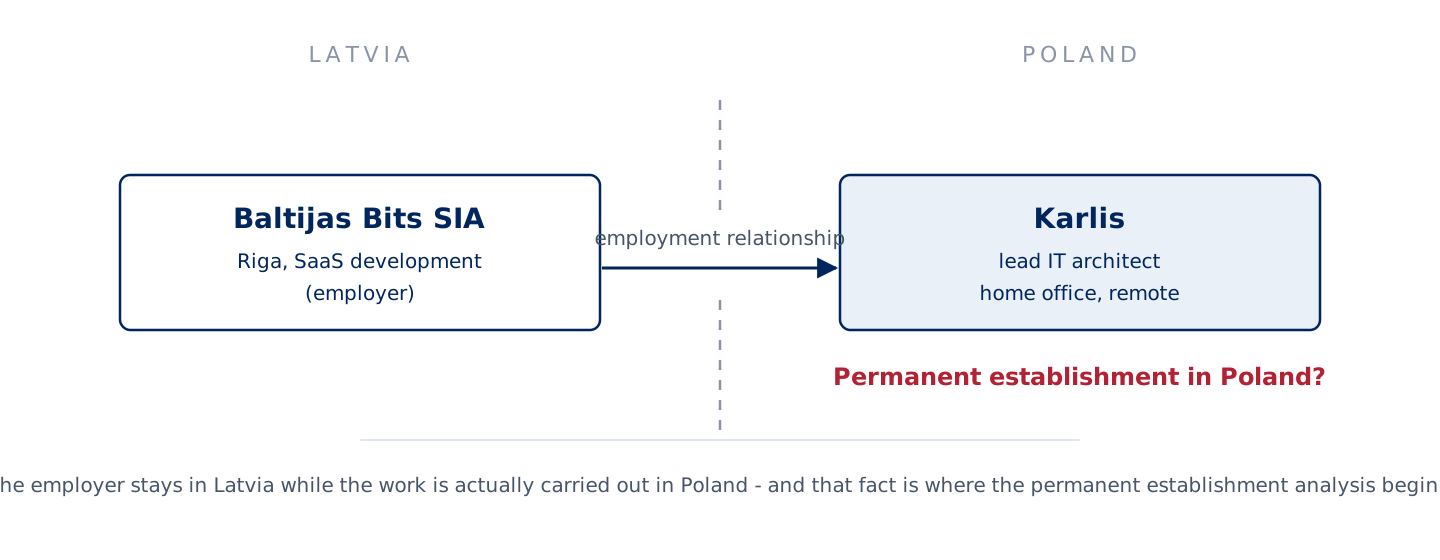
The first question is whether Karlis’s home office in Warsaw creates a PE for Baltijas Bits SIA in Poland.
Does a home office in Warsaw create a permanent establishment?
The analysis proceeds step by step. The first step is permanence: is the place fixed at all. A stay of a few months, or an episodic presence, will not normally create a PE. In Karlis’s case the home office is used on a permanent basis: he has set up a permanent workplace there with his own equipment and works from it day to day, so this condition is met.
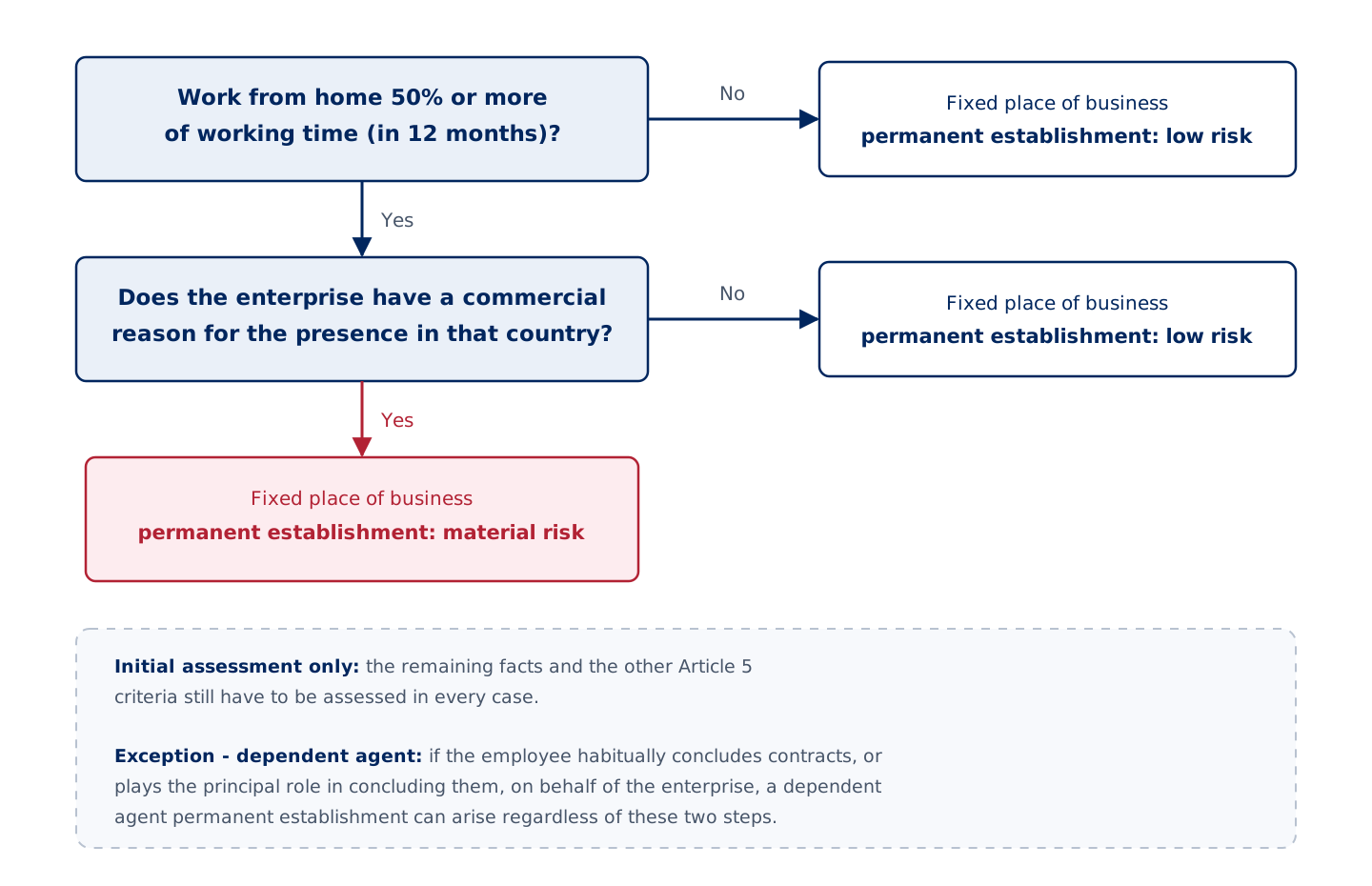
The next step is the time criterion, which in practical terms helps to assess whether the home office can be regarded as a place at the disposal of the enterprise at all: where work from home accounts for less than 50% of total working time in a 12-month period, it generally cannot. Karlis works from home in Poland for almost all of his working time, so the threshold is exceeded; that does not create a PE in itself, but it does mean that the home office may be a place at the disposal of the enterprise. The decisive point in assessing a fixed place of business PE in a home office situation is therefore the commercial reason test, the outcome of which always depends on the specific facts and circumstances.
Scenario one. Karlis relocates to Warsaw for family reasons, and Baltijas Bits SIA allows remote work solely in order to retain him. From Poland he carries out the same product development for the needs of Baltijas Bits SIA that he would carry out in Riga; he does not serve Polish customers and does not meet them. Although Karlis is an employee who is significant to the company and creates value, the company has no commercial interest in his being in Poland specifically, and the PE risk is not that high, even though he works full time from Poland.
Scenario two. Baltijas Bits SIA makes commercial use of Karlis being in Poland: it develops the local customer base, Karlis meets existing Polish customers and business partners, and at the same time brings in new ones. His physical presence in Poland specifically now has a commercial reason, and the fixed place of business PE risk in Poland becomes material; if the other criteria of Article 5 are also met, a PE will most likely arise. The difference between the two scenarios lies not in the volume of work but in the commercial reason - in whether the company makes use of Karlis being in Poland specifically.
In both scenarios Karlis is an employee who is significant to the company and creates value. That role affects the assessment in two ways. For the creation of a PE it marks one of the risk factors, but it does not decide the question on its own: as scenario one shows, the presence of a key employee abroad does not automatically mean that a PE arises there if there is no commercial reason for their physical presence in that country, whereas a less significant employee may create one where such a reason does exist. The employee’s importance alone therefore does not determine whether a home office constitutes a fixed place of business PE. For profit attribution, by contrast, that role matters a great deal, as the next section shows.
Two clarifications. First, following the 2025 update to the Commentaries, it has been made explicit that it is not material who provides the place or the equipment. Even if Baltijas Bits SIA were to find an apartment for Karlis and provide him with a computer and servers, that would not, in itself, create a commercial reason for his location in Poland. Second, the fixed place of business test for a home office and the dependent agent test are distinct from one another. If, in addition to development work, Karlis habitually concluded contracts, or played the principal role in concluding them, on behalf of Baltijas Bits SIA, a dependent agent PE could arise regardless of the 50% threshold and the commercial reason test. What matters is the person’s actual role rather than their job title, and the dependent agent rule is not confined to employees.
The visualisation below summarises the fixed place of business PE assessment in home office situations. It does not dispense with a separate dependent agent PE analysis.
What share of profit is attributable to the permanent establishment?
Assuming that a PE arises in the example, the next step is to determine what share of the profit is attributable to it for Polish CIT purposes. The starting point is to understand the employee’s role: does he perform routine functions, or is he a key employee who provides the company with substantial added value. The rest of the analysis depends on that assessment, including the method used to determine the profit attributable to the PE.
In Karlis’s case the answer is clear: he is the central employee in product development. The Polish PE is therefore due not a nominal mark-up over his costs, but a substantial share of profit matching the development functions he performs. In practical terms this means that part of the profit that would have been taxed in Latvia had Karlis not relocated to Poland moves to Poland.
Profit is attributed to a PE by applying one of the transfer pricing methods used for transactions between related parties. For employees performing support or routine functions, the transactional net margin method (TNMM) or the cost plus method (costs plus a mark-up) will usually serve. For key employees who deliver substantial value, other methods may be more appropriate - the profit split method, for instance - in which case the employee’s actual role in the overall functional and risk profile of the enterprise has to be assessed in detail.
In this particular example, then, if the profit on the product derives largely from the development work led by Karlis, allocating only a small mark-up over payroll costs to the PE would undervalue its contribution; in practice, disputes tend to arise precisely over this excess, or non-routine, share of profit that exceeds the return on routine functions.
An alternative solution: a local company in Poland and transfer pricing
If a PE arises for Baltijas Bits SIA in Poland, part of the profit has to be attributed to the Polish PE, which in turn requires registration and separate records, and brings with it the risk of a dispute over the amount attributed.
In practice, groups often look for a clearer legal form for the relationship. In certain cases, a good solution may be to set up a group company in Poland ("Baltijas Bits Polska"), transfer Karlis’s employment to it, and conclude a services agreement - for research and development (R&D) services, for example - between the Polish and the Latvian company.
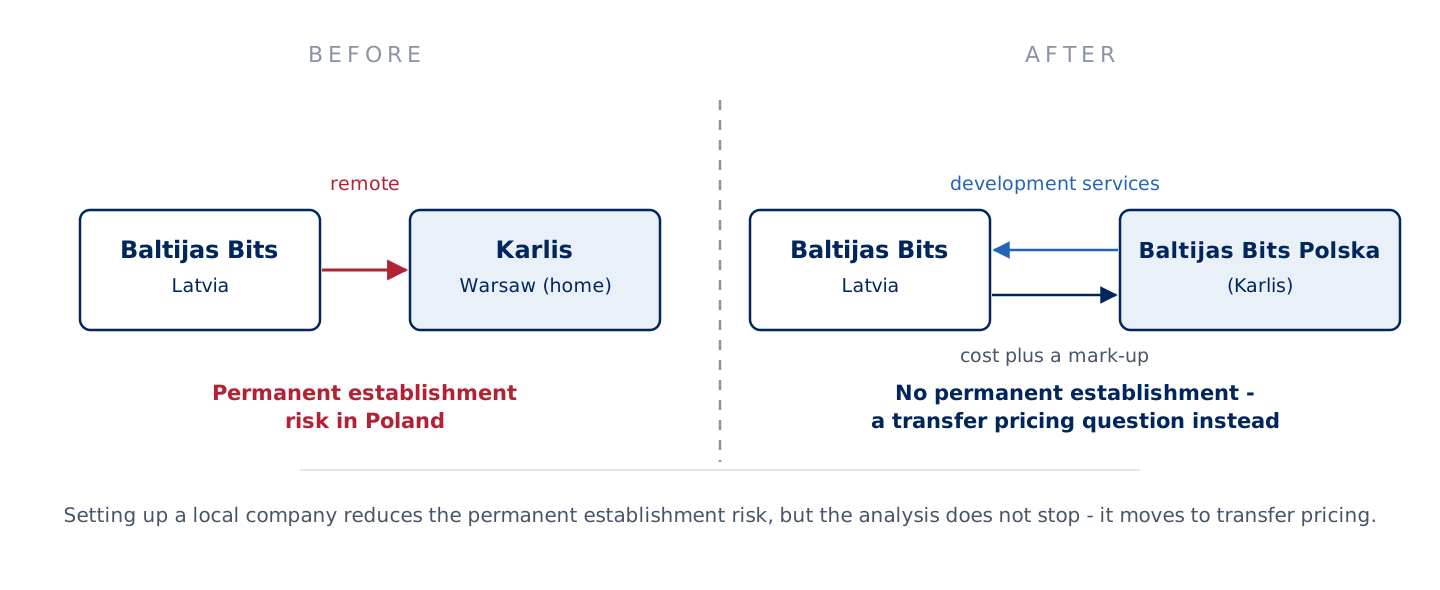
The central question fundamentally stays the same: who derives an identifiable benefit from Karlis’s work. If Karlis is employed by the Polish company but his development work benefits the Latvian company, one company is in substance providing a service to the other, and a services agreement is therefore needed between them, with remuneration and terms that meet the arm’s length principle.
This solution reduces the PE risk considerably, but it does not end the analysis - the question simply moves from the PE to transfer pricing. A functional and risk analysis is still required: who takes the development decisions, who funds them, who owns the output, and who bears the risk if the product fails. If Baltijas Bits SIA retains ownership of the intellectual property and controls the development risks, the Polish company is a contract R&D provider and is due costs plus a reasonable mark-up. If actual control over development rests with Karlis in Poland, a larger share of profit stays in Poland.
The business restructuring question has to be assessed separately. Moving Karlis together with the development function may amount to a restructuring in transfer pricing terms if something of value passes to Poland - a functioning team, intellectual property or profit potential. In that case a question may arise on the Latvian side as to a one-off compensation, much as it would for a disposal of an intangible.
Here too, the price and terms of the transaction are set by the same transfer pricing methods, and the choice of method depends on the actual circumstances - including who controls the risks, who owns the intellectual property and how decisions are taken.
The reverse direction: an employee relocating to Latvia
The same logic works in the opposite direction. So far Karlis has moved from Latvia to Poland; a mirror situation is equally possible, where a developer of a foreign company - a Polish one, say - named Jakub relocates to Riga and continues to work remotely. The question is then the same, with the parties reversed: does a PE arise in Latvia for that foreign company. The steps do not change - permanence, the 50% threshold and the commercial reason test - and, in addition to the treaty, the definition of a PE in Latvian law applies, which is broader in certain respects. If a PE arises, the consequences are specific: registration with the State Revenue Service, separate accounting records and a CIT return covering the profit attributable to Latvia.
When the answer is not clear-cut
In a business setting, scenarios vary widely and are often considerably more complex and less clear-cut than those described here, and the presence of a local company in a given country does not, in itself, rule out the PE risk. Cases are also possible in practice where the group already has a company in that country and yet a PE nonetheless arises there for the company from the first country. In that case a local group company and a PE of the first country’s company coexist in one and the same country, and transactions may arise between them. A tax authority may assess such a structure in different ways - both as regards the profit attributable to the PE and as regards the pricing of transactions between the PE and the local company - and each of these approaches carries its own risks. That is precisely why tax questions have to be assessed carefully while the remote work arrangement is still only being planned.
What does this mean for Latvian employers?
For a Latvian employer the practical sequence is fairly simple. Before an employee starts working permanently from abroad, it is worth answering four questions:
- how much of their working time the employee will actually spend abroad in a 12-month period;
- whether the company has a commercial reason for their presence in that particular country, or whether the move is at the employee’s own initiative;
- what the employee’s role in creating value is, and whether they conclude or prepare contracts on behalf of the company;
- which group company actually benefits from their work, and whether an agreement with arm’s length remuneration is in place for it.
The answers usually already indicate whether a PE is in question at all and what share of profit would be attributable to it. Where they point to a PE risk, the next step is to compare the alternatives: register the PE, set up a local group company with a services agreement, or reorganise the working arrangements so that the threshold is not exceeded. Each of these routes carries its own tax risk and administrative consequences.
Conclusions
Remote work is a significant tax question. The 2025 update to the Commentaries on the OECD Model Tax Convention provides clearer criteria, but it does not change the main conclusion: the answer depends on the actual circumstances and on where value is genuinely created.
The most complex cases are precisely those where the most valuable employees relocate for the long term. If the situation is left unaddressed, the risk does not disappear but accumulates: tax authorities mostly identify a PE with retroactive effect. These questions therefore have to be dealt with before the employee relocates, not after.
The article is also published in iFinanses and available here (in Latvian).