When Remote Work Creates Corporate Income Tax Risks

Remote work has long outgrown its status as a temporary, pandemic-era fix and has settled in as a fully fledged model of work organisation. As a result, companies can bring in specialists regardless of where they are based, while employees can live and work where they choose. From the employer’s perspective, this flexibility raises significant tax questions. Unlike payroll taxes, social contributions and immigration requirements, the corporate income tax (CIT) consequences often go unnoticed until the tax authority identifies them.
I cover the subject in two articles. This one explains when remote work can create a permanent establishment (PE), how taxable profit is attributed to a PE, and how these questions connect to transfer pricing. The second article applies these principles to practical examples. Only CIT questions are covered here; VAT, payroll taxes and other tax considerations - no less important where remote work is concerned - are deliberately left outside the scope.
The underlying principles
The international tax system rested for a long time on practice that took shape before remote work became the norm. As remote work gained ground, the Organisation for Economic Co-operation and Development (OECD) initially addressed the CIT questions through its Covid-19 pandemic guidance, but the more significant changes came at the end of 2025, when the OECD Council approved the . That update explains the effect of remote work on the creation of a PE in considerably greater detail in the Commentary on Article 5 of the convention.
The OECD Model Tax Convention and its Commentaries are not legally binding, yet they carry considerable practical weight: most bilateral tax treaties between states - including those concluded by Latvia - are built on the Model, and tax authorities and courts rely extensively on these Commentaries when interpreting treaty provisions.
In an international tax context, a remote worker can be understood as an individual who is physically present and working in a country other than that of their employer. Where the tax treaty applicable between the countries involved follows the OECD Model, remote work generally raises three main CIT questions for the employer:
- does the employee’s presence abroad create a PE (Article 5 of the treaty);
- if it does - what share of the profit is attributable to that PE (Article 7 of the treaty);
- does remote work require transactions between associated enterprises to be revisited (Article 9 of the treaty).
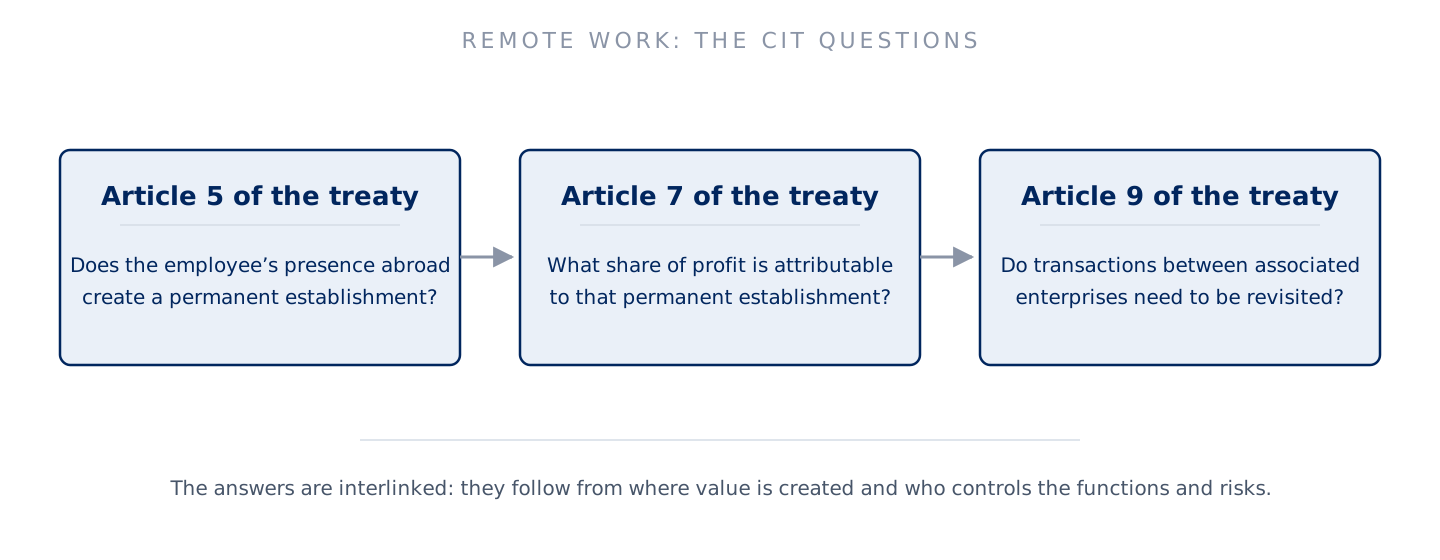
Each of these considerations is addressed separately below.
When does remote work create a permanent establishment?
In direct taxation, the concept of a PE is not harmonised at European Union level; it is determined by the bilateral treaties concluded between states and by each country’s domestic law. In Latvia, the concept is defined by Section 14 of the law "On Taxes and Fees"; where a treaty provides otherwise, the treaty applies.
In remote work situations, a PE arises mainly in two ways:
- first, where the employee has a fixed place of business - including a home office - that is permanent and at the disposal of the enterprise (Article 5(1) of the treaty);
- second, where the employee habitually concludes contracts, or plays the principal role in concluding them, on behalf of the enterprise, that is, a dependent agent PE arises (Article 5(5) of the treaty).
In practice, it is the first of these - the home office as a fixed place of business - that generates the most discussion in a remote work context. An employee’s home is usually both fixed and permanent, so the question is whether it can be regarded as a place at the disposal of the enterprise. This is precisely the criterion that has proved hardest to apply in practice, and national approaches diverged for a long time.
Even before the 2025 update to the OECD Commentaries, authorities and courts in several countries had reached similar and logical conclusions. In 2024, the German Federal Ministry of Finance accepted that an ordinary employee home office does not create a PE because it is not at the disposal of the enterprise - even where the employer covers its costs or provides no other workplace. In 2023, Belgium and the Netherlands agreed on a numerical threshold: where an employee works from home for no more than 50% of working time in a 12-month period, no PE arises. In 2025, the Supreme Administrative Court of Poland held that an employee’s home does not constitute a PE where the enterprise has no legal title, control or access to those premises, while the Italian Revenue Agency has emphasised that remote work does not, in itself, alter the PE criteria.
The 2025 update to the Commentaries on the OECD Model Tax Convention consolidated this direction. The earlier "at the disposal of" test has not been abolished, but it is now explained in greater detail. What matters is the commercial interest of the enterprise in the employee being in that particular country, rather than mere formal presence, and the link between the home office and the enterprise is assessed by reference to both the amount of working time and the commercial reason.
Accordingly, under the new Commentaries, the amount of working time carries significant weight in remote work situations: working from home or another private location for less than 50% of total working time in any 12-month period will generally not create a place of business of the enterprise. Alongside that, it is important to assess whether the enterprise has a commercial reason for the employee to be present in that specific country - for instance, because customers, suppliers or other resources significant to the enterprise’s business are located there. Retaining or attracting an employee, like a saving in costs, does not count as such a reason. The interpretation of the dependent agent PE is unchanged by this update. The situation where the employee is the only person carrying on the business of the enterprise in that country calls for a separate assessment.
What share of profit is attributable to a permanent establishment?
Once a PE is established, the next step is to determine what share of the profit is attributable to it for CIT purposes (Article 7 of the treaty). A PE is taxed as if it were a separate and independent enterprise engaged in the same or similar activities under the same or similar conditions, taking into account the functions it performs, the assets it uses and the risks it assumes.
In a remote work context this means that, where an employee’s presence abroad creates a PE, a certain profit must be attributed to that PE for CIT purposes. How large that share is depends on what the employee actually does. If they perform functions that are significant to the enterprise and create substantial value - leading product development or key customer relationships, for example - part of the substantial core (non-routine) profit may be attributable to the PE, that is, a return exceeding the remuneration for support or routine functions. If the employee performs mainly routine or support functions, the return attributable to the PE is usually more modest and closer to costs plus a set mark-up.
The OECD approach to applying Article 7 has changed over time. Until 2008, wider departures from the arm’s length principle were permissible and the relevant business activity approach was applied; with the 2008 and 2010 versions, the OECD moved to the authorised OECD approach (AOA). The AOA treats the PE as a functionally separate entity whose profit is determined primarily by the functions performed by the PE’s personnel.
In Latvia’s case, one nuance matters: in its tax treaties Latvia has reserved the right to apply the version of Article 7 that was in force before 2010. This means that Latvia does not apply the authorised OECD approach in full.
How does remote work affect transactions between associated enterprises?
The CIT impact of remote work also has to be assessed from a transfer pricing angle. Transactions between associated enterprises are governed by Article 9 of the tax treaties, the transfer pricing rules of the country concerned and the OECD Transfer Pricing Guidelines, all of which rest on the principle that transactions between related parties must comply with the arm’s length principle. Although the OECD Guidelines are not a directly binding source of law, they are the internationally recognised transfer pricing standard, used by multinational enterprises and tax authorities alike.
Transfer pricing questions can arise in a wide range of situations. A typical example is an employee relocating to a country where the group already has a registered company. Equally common are situations where an employee is employed by a company in one country, physically works in a second, and through their work generates a benefit for a group company in a third.
Whatever the situation and the operating model, the decisive question for tax purposes is this: which group company derives an identifiable benefit from the employee’s work. Where one company employs the individual but their work benefits another, the first company is in substance providing value to the second, and an arm’s length return is due for it. Where no return is paid, the second company obtains that value for free, and the tax authority may identify an uncompensated related-party transaction and adjust the tax base.
When assessing the transfer pricing impact and risks in a remote work context, several key questions have to be answered in practice, among them: does remote work change the actual substance of the transaction between the related parties; does the transaction have a commercial rationale; is the selected transfer pricing method appropriate.
The cases that matter most are those where a value-creating function moves to another country together with the employee. This may amount to a business restructuring in transfer pricing terms, for which a one-off compensation may be payable - much as it would be for a disposal of an intangible.
The answers depend largely on a full functional and risk analysis: who actually performs and controls the significant, value-creating functions, who controls the risks and has the capacity to assume them, and who owns the output of the work. The price is ultimately set by what unrelated parties would agree in comparable circumstances.
What does this mean for Latvian employers?
Remote work from abroad can create CIT risks for a Latvian company even where the company itself has not formally set up any operations in that country. In certain circumstances, an employee’s presence in another country can create a PE, an obligation to attribute part of the company’s profit to it, and transfer pricing questions within the group.
Latvian companies have to take into account both the domestic rules of the foreign country and the applicable tax treaty. What matters is not which country is named in the employment contract, but where the employee actually works, how regularly and for how long they are there, what functions they perform, and whether the company has a commercial reason for their location. Within a group, it is also necessary to assess which company actually benefits from the employee’s work.
These questions are best assessed before the employee starts working abroad on a permanent basis. Early analysis makes it possible to identify potential tax obligations, put the employment and intra-group arrangements in order, and reduce the risk of the consequences surfacing only later. In practice, cross-border employment questions are far easier to settle before the employee relocates than afterwards.
Conclusions
The three questions discussed here are interlinked, and the answers to them ultimately follow from where value is created and which party actually controls and assumes the functions and risks concerned. It is worth emphasising that the 2025 OECD update is a significant step forward: compared with previous practice, it provides greater certainty, reduces interpretation risk and offers a more uniform approach to assessing whether a PE exists. Even so, the update does not replace a factual analysis - each case has to be assessed separately on its own facts.
The second part applies this analysis in practice: it looks at typical scenarios, sets out the decision logic, and works through a specific Baltic example covering the PE, profit attribution and transfer pricing.
The article is also published in iFinanses and available here (in Latvian).