When can the tax authority challenge a holding structure? The CJEU’s judgment in “Neo Group” (C-203/25)


On 15 October 2026 the Court of Justice of the European Union (CJEU) delivered its judgment in Case C-203/25 “Neo Group”. The dispute concerns dividends that a Lithuanian company paid to its Cypriot parent under the exemption from withholding tax. The money then reached the group’s ultimate owner through a series of further transactions.
We covered the facts of the case and Advocate General Juliane Kokott’s Opinion in June here. The full text of the judgment is available here.
A brief reminder of the case
In 2016 and 2017 “Neo Group” UAB and another Lithuanian group company paid dividends to their Cypriot parent. The exemption from withholding tax was applied (as provided for by the EU Parent-Subsidiary Directive). The parent carried on genuine economic activity, and the Lithuanian tax authority (VMI) did not dispute that. Its objections concerned what happened next.
The group’s top holding company in Belize then sold the shares in the parent to a newly incorporated Cypriot company within the group. Payment of the purchase price was deferred for several years. The Belize company assigned the purchase-price receivable to an individual resident in Cyprus who owned the shares in both the seller and the buyer. The new holding company received dividends from the parent. For a similar amount, it granted loans to the individual and assigned receivables to her. These were then set off against her claim for the share price. No dividends were paid to the individual.
The VMI treated this chain of transactions as non-genuine (in the Directive’s words, an arrangement that is not genuine) and designed to avoid tax on the dividends. It assessed “Neo Group” for withholding tax together with late-payment interest and penalties. The Lithuanian Tax Disputes Commission referred six questions to the CJEU.
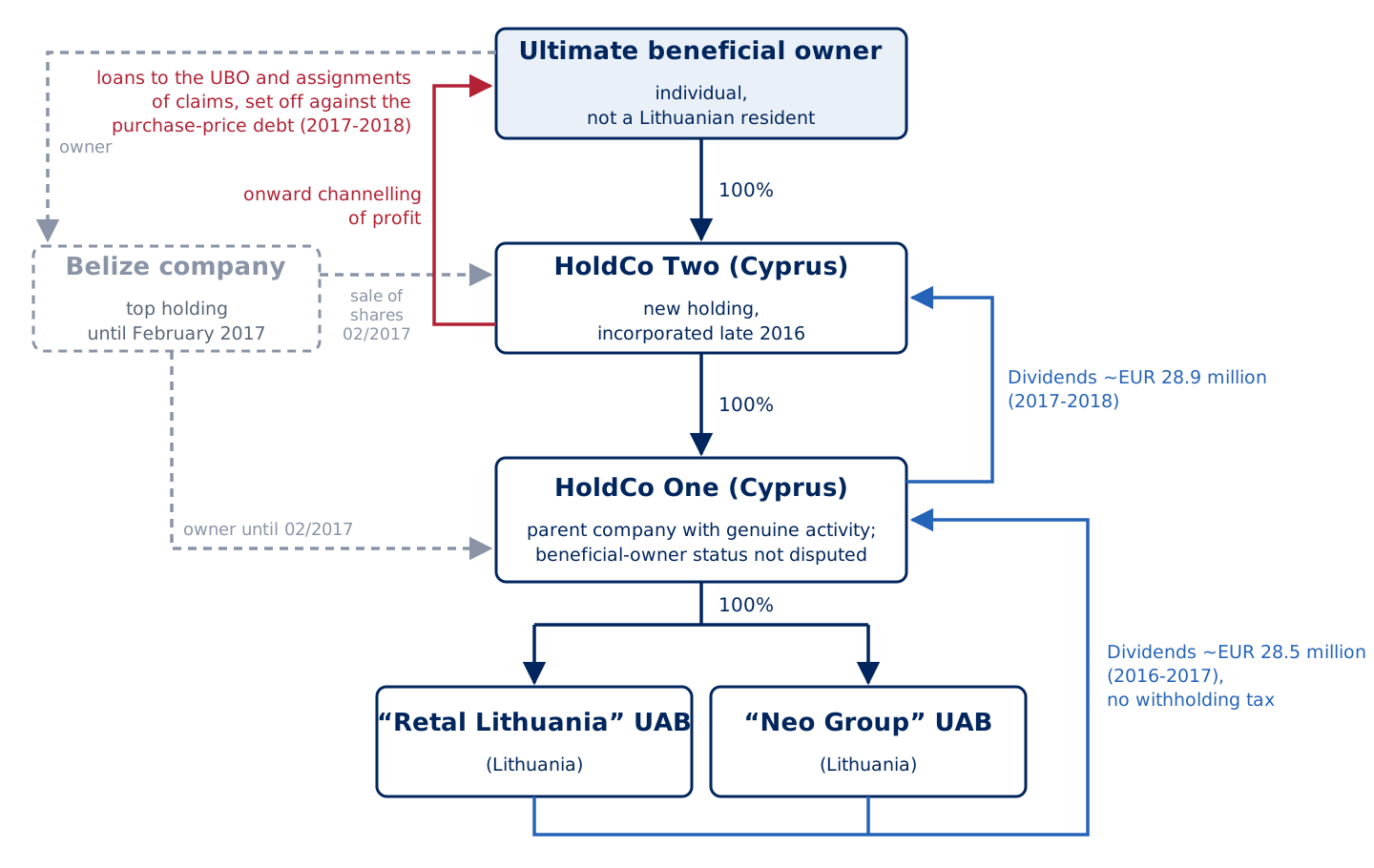
For a more detailed account of the case, see our earlier article: Can the tax authority challenge any holding structure? The Advocate General’s Opinion in “Neo Group” (C-203/25).
The questions and the CJEU’s answers
A parent with genuine economic activity within a chain of transactions
Question. “Neo Group” paid dividends to its Cypriot parent, which carries on genuine economic activity and is the beneficial owner of the dividends. The VMI nevertheless regards it as a participant in a non-genuine chain of transactions through which the dividends reach the group’s owner. May Lithuania refuse the withholding-tax exemption?
Answer. In principle, yes. The Directive’s anti-abuse rule is not limited to particular situations or types of arrangement. The Court referred to the Danish cases ( and ), noting that the conduit-company situations considered there are only one example of abuse. Genuine activity at the parent does not, in itself, rule out abuse. The other and further steps in the chain must be examined too - the sale of shares, the loans and the assignments of receivables. The burden of proof lies with the tax administration.
The Court did not interpret the Lithuania-Cyprus tax treaty. It did note, however, that under the OECD Model Commentary beneficial-owner status does not in itself confer a right to treaty relief where abuse is found.
Matching amounts and gradual onward distribution
Questions. The VMI relied on the correspondence between the amounts at the various steps of the chain and on the fact that the parent passed the dividends on gradually over a longer period. Are these circumstances relevant to establishing a non-genuine arrangement?
Answer. Yes, both are. The administration may take into account, as a relevant circumstance, the correspondence between the dividends received by the parent and the amounts reaching the person who controls the group. It may not base a general presumption of abuse on it. A short interval between receipt and onward distribution may be a significant indication. Likewise, the fact that dividends are passed on regularly over a longer period, rather than shortly after receipt, does not in itself rule out abuse of the Directive. In every case an objective analysis of all relevant facts and circumstances is required.
Transactions in another Member State and the recipient of the advantage
Questions. The transactions the VMI regards as non-genuine took place in Cyprus between Cypriot residents. The tax advantage at the end of the chain was obtained by the individual. May Lithuania apply the anti-abuse rule in this situation too, and does it matter at which step of the chain the advantage arose?
Answer. Yes, it may. The Directive always concerns cross-border situations, so abuse of it must be assessed more broadly as well. The assessment may cover transactions in another Member State both before and after the dividend was paid. Here the Court referred to last year’s judgment in : an arrangement may lose its commercial justification if it is maintained after the commercial reasons for it have ceased. Nor is there any precondition that the advantage must be obtained by the company paying the dividend. It may arise at any step of the chain, including at the level of an individual who controls the group and is resident in another Member State.
Did the paying company need to know about the full chain of transactions?
Question. The VMI did not examine whether “Neo Group” knew or could have known about the chain of transactions above it. May the VMI apply the anti-abuse rule without such an assessment?
Answer. Yes, provided it is established that at least one group company participating in the chain, or the individual who obtains the advantage at its end, knew or could have known about it. A finding of abuse requires a subjective element - the intention to obtain an advantage by artificially creating the conditions for it.
Comparison with the Advocate General’s Opinion
The Advocate General and the Court reached the same basic conclusion: the exemption may be refused even where the parent carries on genuine economic activity. The Advocate General, however, reasoned more narrowly in her Opinion. In her view, refusing the withholding-tax exemption is permissible where the dividend payment was, from the outset, part of a plan to let the final recipient avoid tax. The Court did not set these conditions.
Status of the proceedings
The case returns to the Lithuanian Tax Disputes Commission. It must assess whether the arrangement or its steps are non-genuine and whether their main purpose, or one of their main purposes, was a tax advantage contrary to the Directive.
What does this mean for Latvia?
The State Revenue Service (VID) may rely on the Court’s interpretation in its practice, and taxpayers have to take it into account.
Latvia’s corporate income tax (CIT) system does not, in the usual cases, provide for a classic withholding tax on dividends paid to an EU parent, so this situation does not normally arise with Latvia as the paying State. Latvian companies, however, are often holding or intermediate holding companies in cross-border groups. Withholding tax does exist in the countries of their subsidiaries, and the tax administrations of those countries may rely on the judgment when examining what happens to the dividends in Latvia and beyond.
In June we wrote that what matters is the ability to justify the Latvian company’s role and functions in the structure. The new CJEU judgment adds to that: the entire chain of transactions up to the ultimate owner must be assessed, covering different types of transactions, including over a longer period. The Directive’s anti-abuse rule requires a substance-over-form assessment of the entire chain, irrespective of the country or the step of the chain at which the tax advantage arises. Groups with cross-border dividend flows should therefore assess the impact of the judgment case by case.