When does a company need a transfer pricing policy and documentation?
Every transaction with a related party must be at arm’s length - whatever its value, and even when both parties are Latvian companies. The obligation to prepare transfer pricing documentation and to file a controlled transactions report (KDP) with the State Revenue Service (VID), however, only arises once a company’s controlled transactions for the year exceed the statutory thresholds.
In practice, companies usually have one question: does this apply to us? The answer depends on three things - who the transactions are with, what they add up to over the reporting year, and how large the group is. Below we summarise the key requirements; the presentation walks through them step by step.
Transfer pricing requirements

The arm’s length principle applies to every transaction
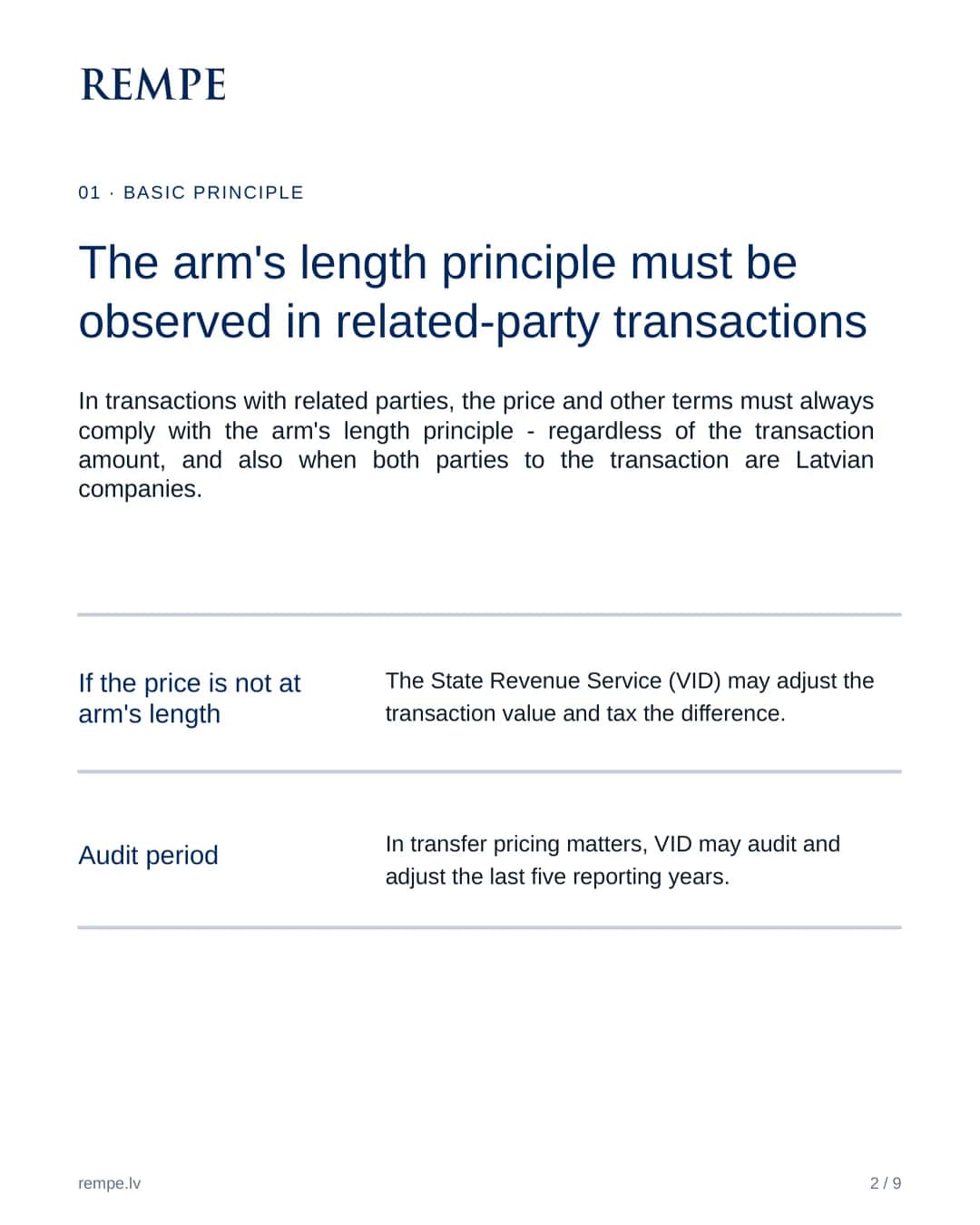
In related-party transactions, the price and other terms must always comply with the arm’s length principle. There is no threshold below which it stops applying: it covers small transactions as well as large ones, and transactions between two Latvian companies too.
If the price or terms are not at arm’s length, VID may adjust the transaction value and tax the difference. In transfer pricing matters, VID may audit and adjust the last five reporting years. A pricing decision taken today can therefore be scrutinised years later - by which time the support for it has to be pieced together after the fact.
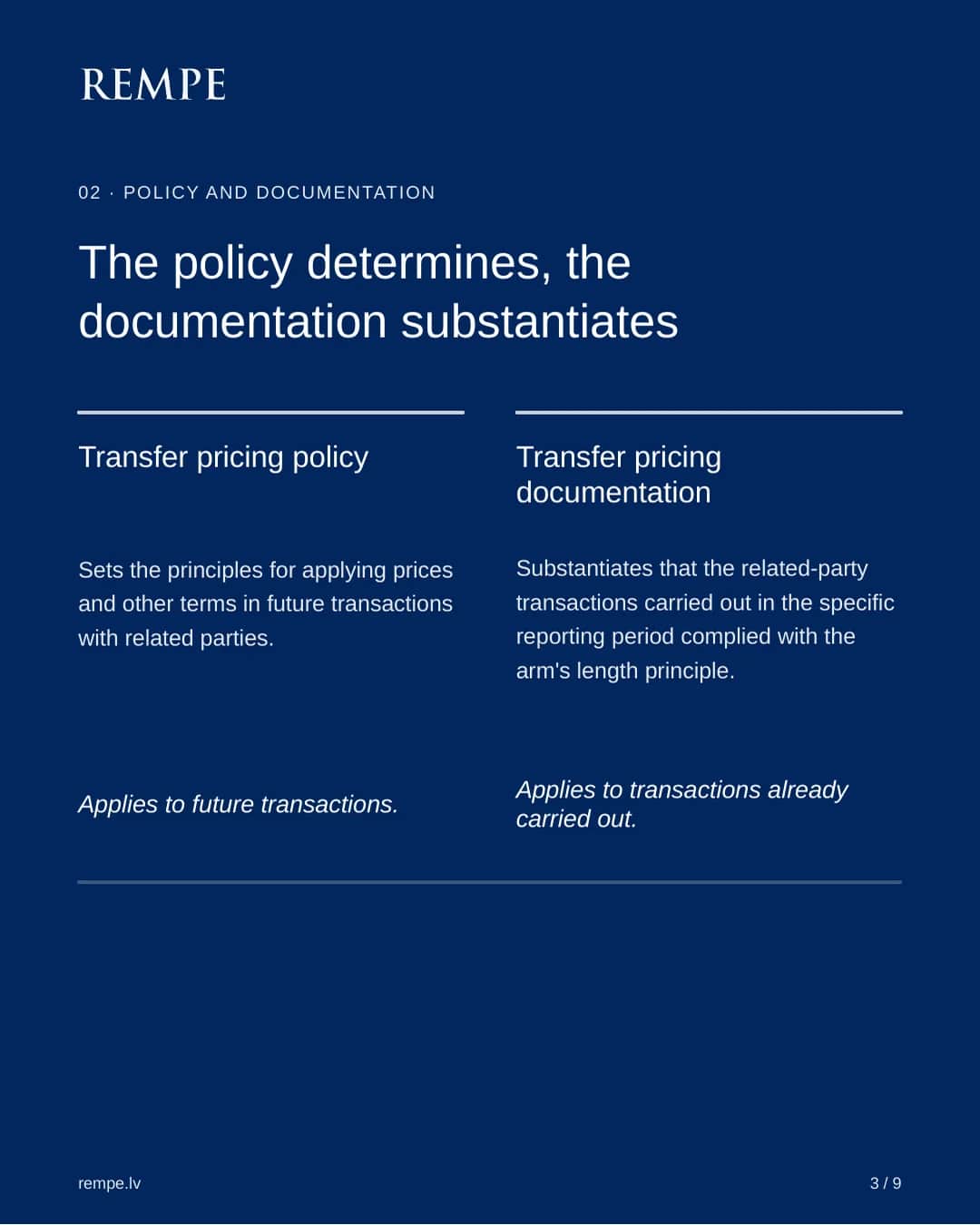
The policy determines, the documentation substantiates
A transfer pricing policy and transfer pricing documentation are often treated as one and the same, but they do different jobs. The policy looks forward: it sets the principles for pricing and other terms in future transactions with related parties. The documentation looks back: it substantiates that the related-party transactions carried out in a given reporting period complied with the arm’s length principle.
In practice, what works best is a policy that is in place before the transactions happen. The documentation then confirms what has already been done, rather than trying to justify, a year later, prices that were set without a clear principle.
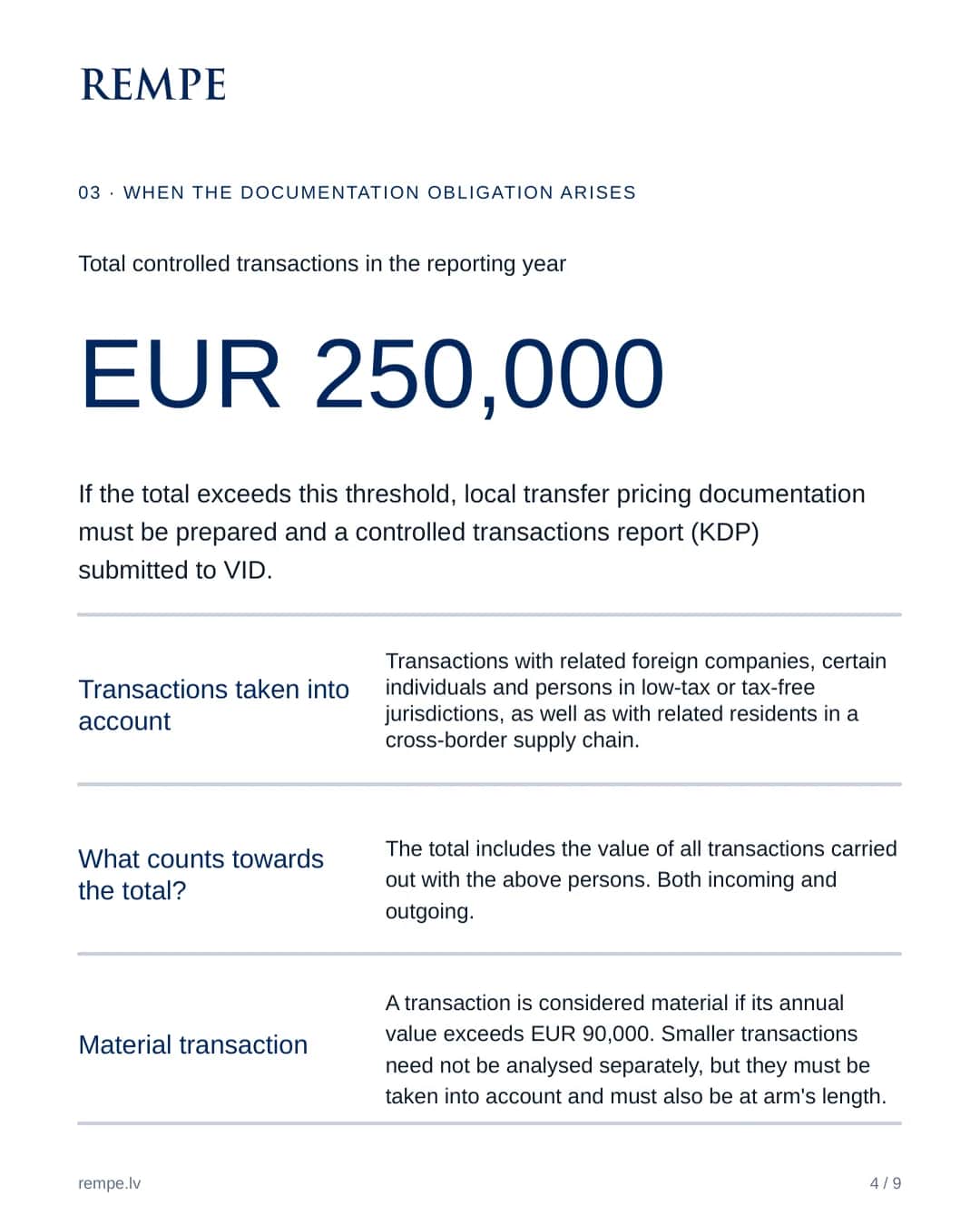
When does the documentation obligation arise?
The key threshold is EUR 250,000 in total controlled transactions in the reporting year. Above it, the company must prepare local transfer pricing documentation and file a KDP with VID.
The total takes into account transactions with related foreign companies, certain individuals specified in the law, and persons located, established or incorporated in low-tax or tax-free countries or territories. It includes the full value of all transactions with these persons - both incoming and outgoing. This is where the threshold tends to be underestimated: purchases, sales, services and loans are looked at separately, none of them seems close to EUR 250,000, yet together they exceed it.
A transaction is material if its annual value exceeds EUR 90,000. Smaller transactions need not be analysed separately, but they count towards the total and must also be at arm’s length.
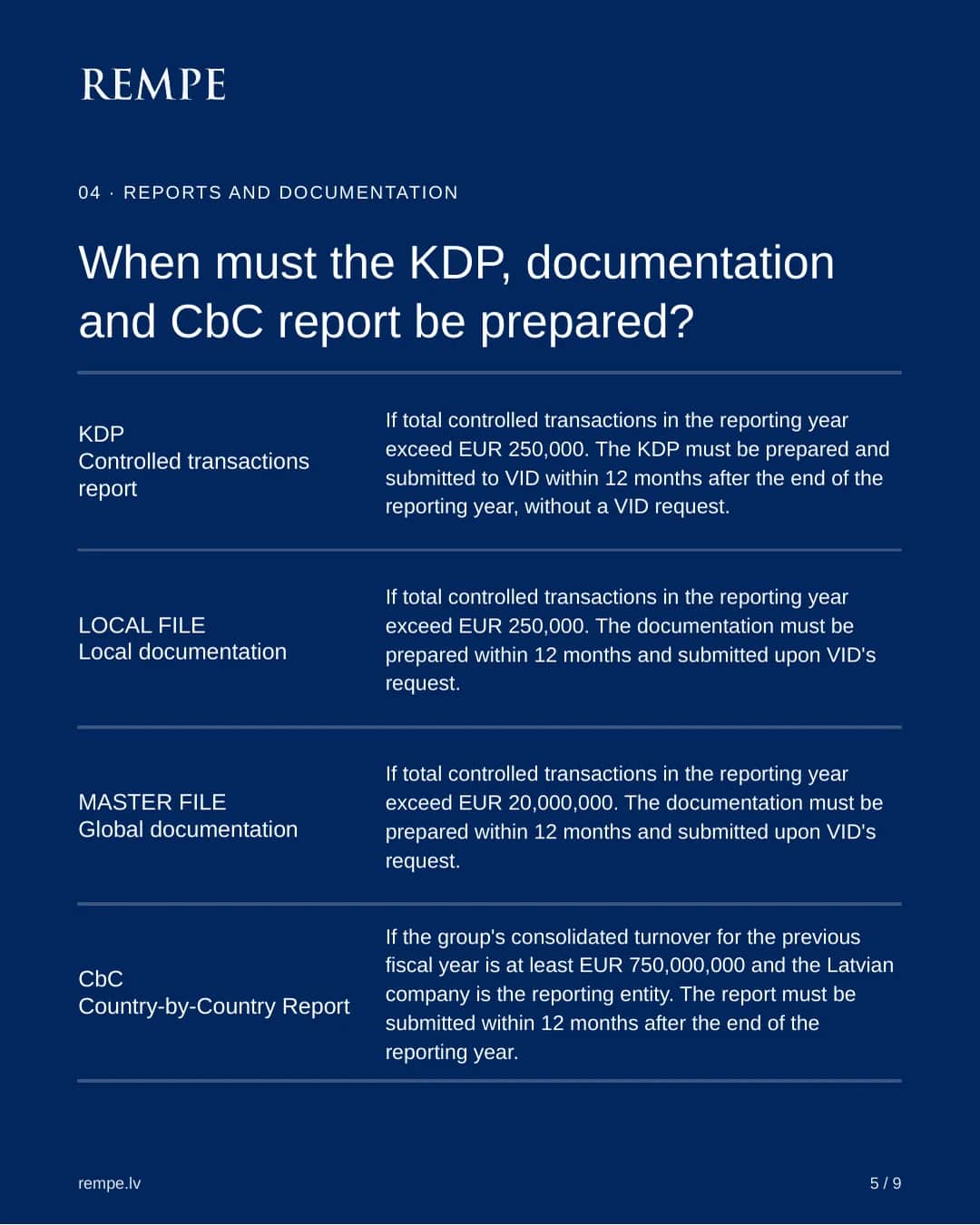
KDP, local file, master file and CbC report
As transaction volumes and group size grow, so do the requirements. In summary:
| Document | When required | Preparation and submission |
|---|---|---|
| Controlled transactions report (KDP) | Total controlled transactions in the reporting year exceed EUR 250,000 | Prepared and submitted to VID within 12 months after the end of the reporting year, without a VID request |
| Local file | Total controlled transactions in the reporting year exceed EUR 250,000 | Prepared within 12 months after the end of the reporting year, submitted within 30 days of a VID request |
| Master file | Total controlled transactions in the reporting year exceed EUR 20,000,000 | Prepared within 12 months after the end of the reporting year, submitted upon VID’s request |
| Country-by-country report (CbC) | The group’s consolidated turnover for the previous fiscal year is at least EUR 750,000,000 and the Latvian company is the reporting entity | Submitted within 12 months after the end of the reporting year |
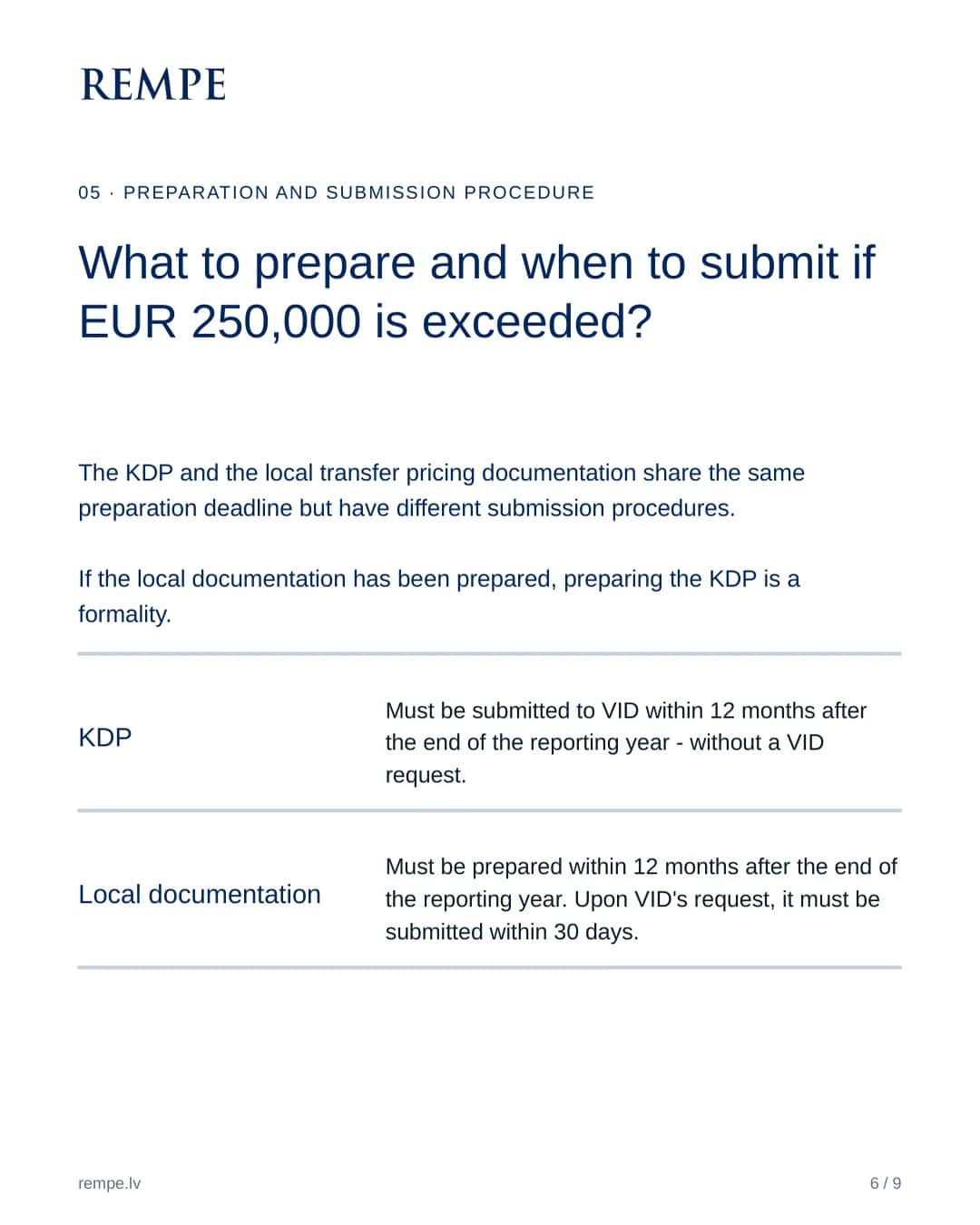
One preparation deadline, two submission procedures
Once the EUR 250,000 threshold is exceeded, the KDP and the local file share the same preparation deadline - 12 months after the end of the reporting year. What differs is submission: the company files the KDP with VID on its own initiative, without a request, while the local file must be submitted within 30 days of VID asking for it.
Both rest on the same data. If the local file has been prepared, the KDP is a formality. If it has not, the KDP has to be completed with information the company does not yet have - and at that point it is no longer a technical exercise.
For companies whose reporting year is the calendar year, the first KDP - for 2025 - is due by the end of 2026. We wrote about what the KDP changes for transfer pricing risk in June.
What must the KDP state for each material transaction?
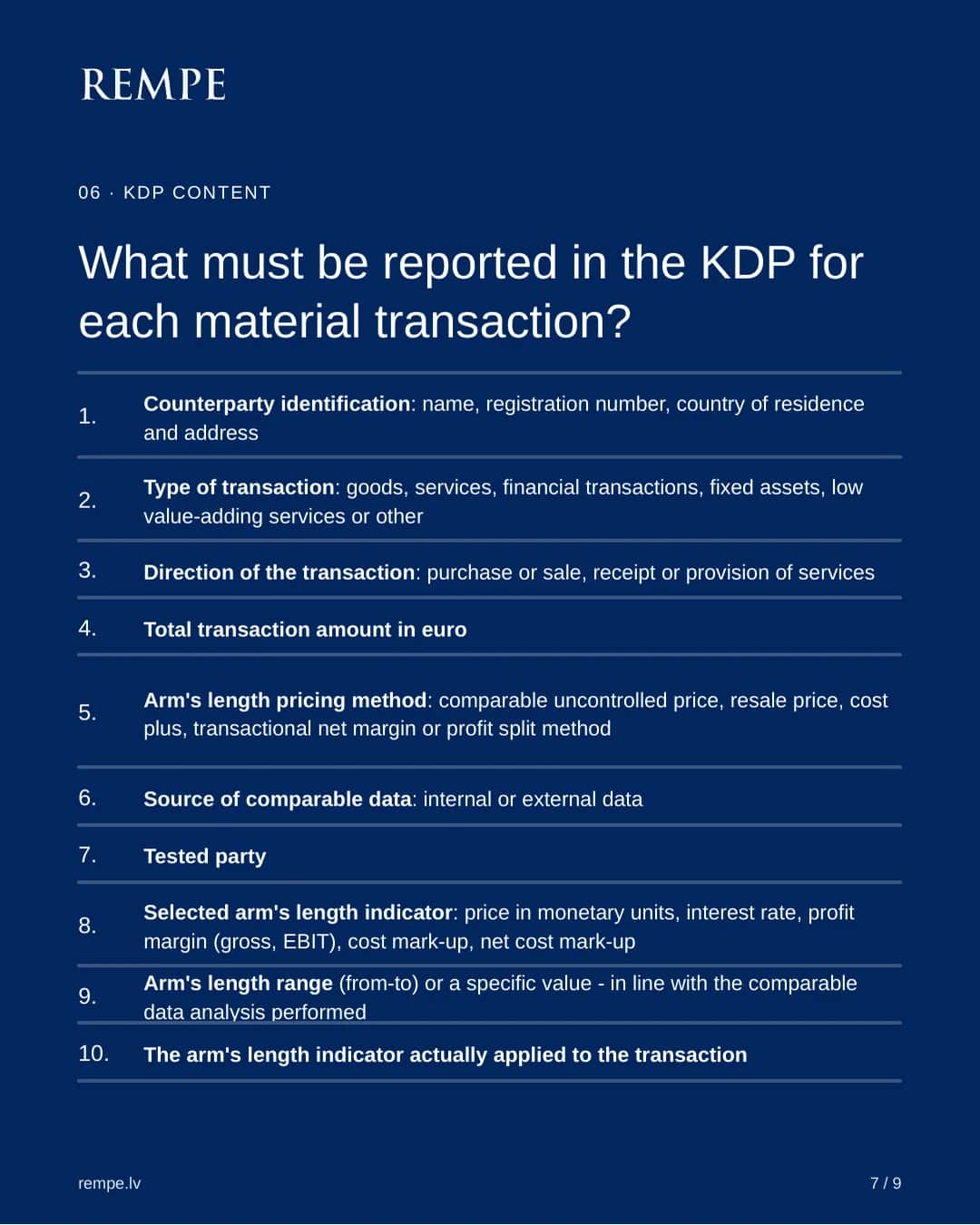
For each material transaction, the KDP must state:
- Counterparty identification: name, registration number, country of residence and address;
- Type of transaction: goods, services, financial transactions, fixed assets, low value-adding services or other;
- Direction of the transaction: purchase or sale, receipt or provision of services;
- Total transaction amount in euro;
- Arm’s length pricing method: comparable uncontrolled price, resale price, cost plus, transactional net margin or profit split method;
- Source of comparable data: internal or external;
- Tested party;
- Selected arm’s length indicator: price in monetary units, interest rate, profit margin (gross, EBIT), cost mark-up, net cost mark-up;
- Arm’s length range (from-to) or a specific value, in line with the comparable data analysis performed;
- The arm’s length indicator actually applied to the transaction.
The first four items come straight from the accounting records. The remaining six cannot be completed without a comparability analysis - they are the output of transfer pricing documentation.
What are the consequences of non-compliance?
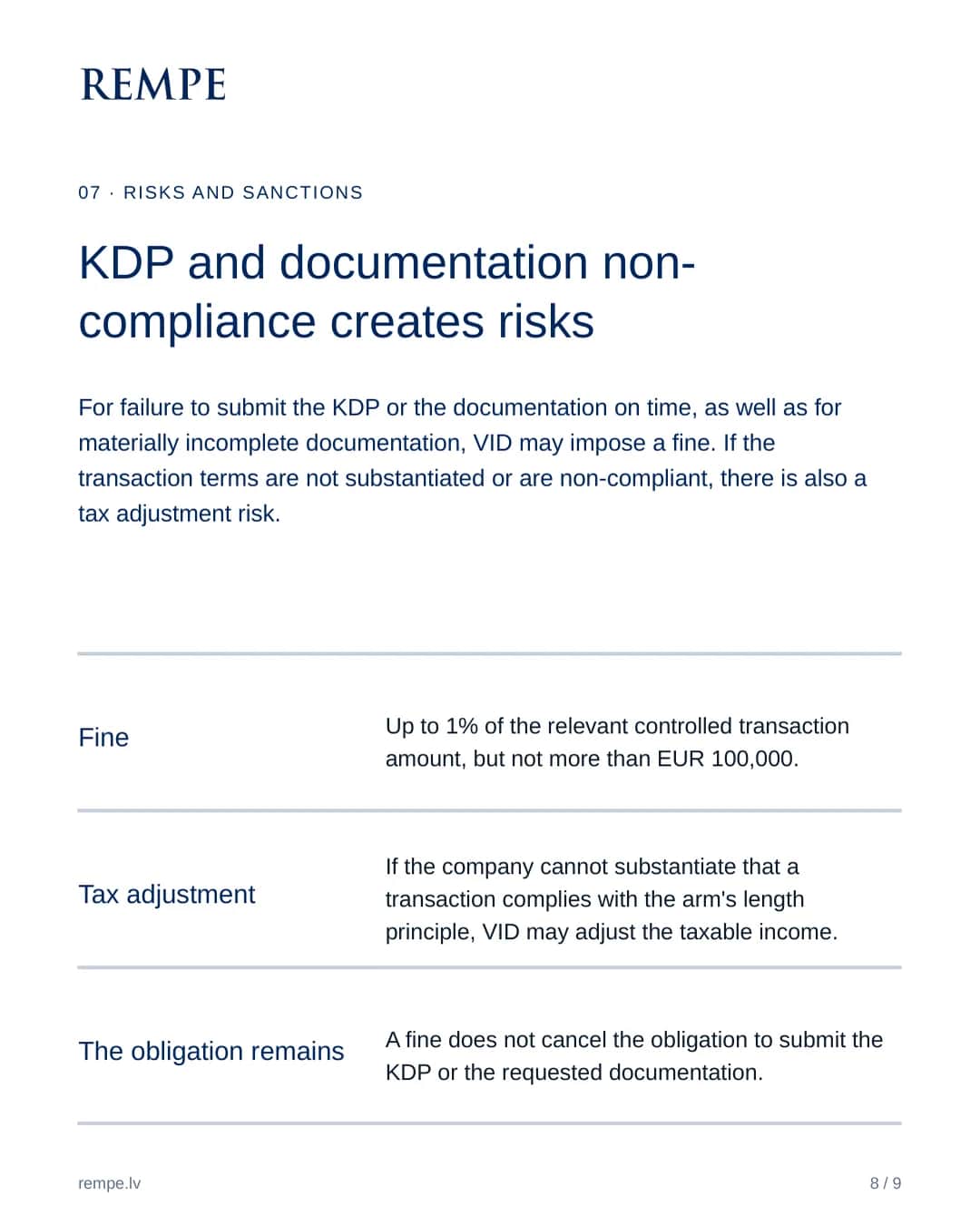
For failure to submit the KDP or the documentation on time, and for materially incomplete documentation, VID may impose a fine of up to 1% of the relevant controlled transaction amount, capped at EUR 100,000. A fine does not cancel the obligation to submit the KDP or the requested transfer pricing documentation.
Financially, the tax adjustment is often the bigger exposure. If the company cannot substantiate that a transaction is at arm’s length, VID may adjust its taxable income - and with a five-year audit window, that adjustment can span several years.
What should you check now?
- Related parties. All related parties and all transactions with them have been identified, including individuals and persons in low-tax or tax-free countries or territories.
- The total. Total controlled transactions for the reporting year have been calculated, counting both incoming and outgoing transactions.
- Material transactions. It is clear which transactions exceed EUR 90,000 and therefore need to be analysed separately.
- Deadlines. If EUR 250,000 is exceeded, the local file is being prepared and the KDP will be filed within 12 months after the end of the reporting year.
- Policy. The group has a transfer pricing policy that sets prices for future transactions rather than only justifying past ones.
If your company carries out transactions with related parties, we will help you assess them, determine the applicable requirements and prepare the necessary documentation. Find out more about our transfer pricing services.